
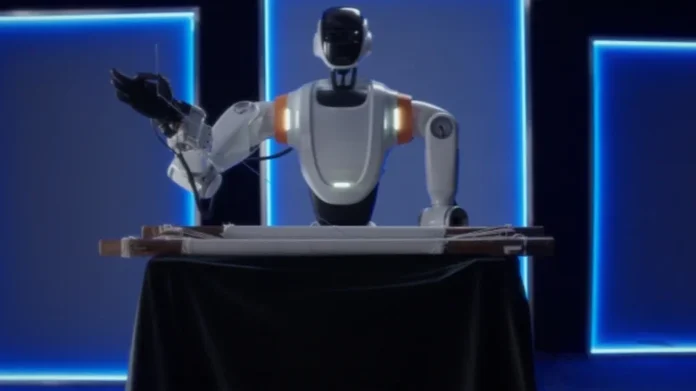
The race to commercialize humanoid robots in China has just received a massive injection of capital. Caixin Global reports that TARS, a Chinese AI robotics startup founded just over a year ago, announced it has raised $455 million in a pre-A funding round. This staggering figure sets a new record for the largest single-round financing in the country’s rapidly expanding humanoid robotics sector, underscoring the intense investor appetite for embodied intelligence.
The funding round was co-led by a powerhouse consortium of investors, including GL Ventures, HongShan (formerly Sequoia Capital China), and tech giant Meituan. Crucially, the round also saw significant participation from state-backed entities, notably the Beijing Robotics Industry Development Investment Fund. This blend of top-tier private venture capital and strategic state support underscores the national priority of dominating the next generation of robotics.
A Founding Team with Autonomous Driving Pedigree
TARS was established in February 2025 by a team of former autonomous driving executives. This origin story is increasingly common in the Chinese robotics landscape, where the complex challenges of perception, decision-making, and control in self-driving cars directly translate into the requirements of embodied AI. The transition of talent from autonomous vehicles to robotics is accelerating, as engineers seek to apply their expertise to platforms that interact more dynamically with the physical world.
The $455 million capital injection provides TARS with a formidable war chest to accelerate its research and development, scale up manufacturing capabilities, and aggressively recruit top talent. The company’s flagship product, the TARS A1 robot, is positioned to compete in a crowded yet highly lucrative market spanning industrial automation, logistics, and, eventually, consumer applications.
The Broader Push for Embodied Intelligence
The record-breaking funding for TARS comes amid intense activity in China’s robotics sector. The government has explicitly identified humanoid robots as a strategic emerging industry, aiming to establish a robust domestic supply chain and achieve mass production capabilities by 2025, with global leadership targeted for 2027.
This massive investment aligns with broader trends in the Chinese tech ecosystem, where capital is increasingly flowing toward hard tech and deep tech ventures. Just days ago, Luminous Ventures closed a $730M fund, following closely on the heels of BlueRun Ventures’ $560M close, signaling a robust institutional appetite for AI and hardware startups.
Meituan’s involvement as a co-lead investor is particularly noteworthy. As one of China’s largest tech companies, with a massive footprint in food delivery and local services, Meituan has a clear strategic interest in automation and robotics. Their investment in TARS suggests a long-term vision where humanoid robots could eventually play a role in their vast logistics and service networks.
As TARS deploys its newly acquired capital, the company will face intense competition from both domestic rivals and international players. However, with a record-setting war chest and strong backing from both private and state investors, TARS is now positioned as a heavyweight contender in the race to bring humanoid robots out of the laboratory and into the real world.