
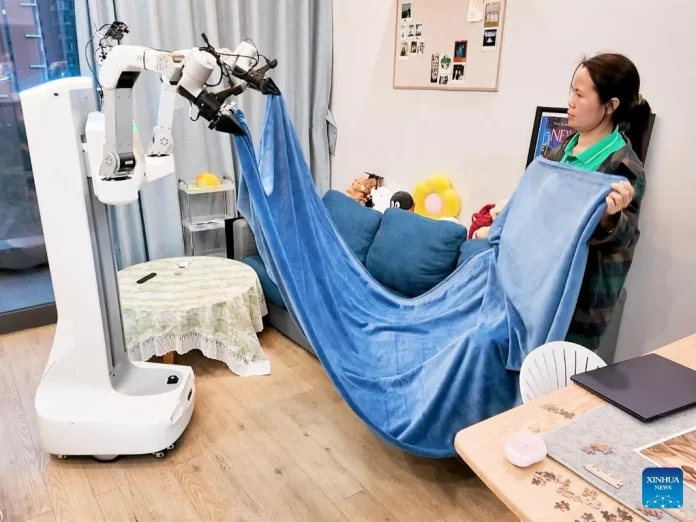
The era of embodied artificial intelligence is moving from the laboratory into the living room. Xinhua reports that X Square Robot, a Shenzhen-based startup, has partnered with the home services platform 58.com to launch a commercial home cleaning service that pairs human workers with humanoid robots. The service, which debuted in Shenzhen in March and expanded to Beijing on April 21, represents one of the first large-scale deployments of humanoid robots in domestic settings, a milestone that underscores both the ambitions and the current limitations of China’s embodied AI sector.
The Service Model
Priced at 149 yuan (approximately $22) for a three-hour session, the service utilizes a carefully designed division of labor between human and machine. The robot, which features a wheeled base and two mechanical arms, is tasked with basic chores such as picking up scattered trash, organizing shoes and toys, and replacing garbage bags. Meanwhile, the human cleaner focuses on more complex, detailed work in kitchens, bathrooms, and bedrooms while also managing client interactions. To ensure smooth operation during this early phase, an engineer accompanies the robot and the cleaner during service visits.
For Lei Xiaoli, a 43-year-old cleaner in Shenzhen, the robot has become a genuine working partner after more than 20 sessions together. “It can identify areas that need cleaning on its own, which reduces my workload,” she said. She expressed hope that future iterations might handle physically demanding tasks, such as cleaning windows or carrying heavy items, thereby reducing physical strain and safety risks for human workers.
Early Customer Feedback
Early customer feedback has been cautiously optimistic. Ge Landong, a customer in Shenzhen, deliberately scattered household waste across his living room to test the robot’s abilities. “Whether it was a banana peel or small chicken bones, it could accurately recognize, pick them up and throw them into the trash,” he reported. “Its perception and precision exceeded my expectations.” However, Ge also noted that the robot’s bulk prevents it from accessing tight spaces, and its current capabilities are limited to simple tasks, meaning a human cleaner must still handle the finer details.
X Square Robot has acknowledged these constraints. In a social media post on April 15, the company stated that the robot currently moves more slowly than humans and requires further improvement to adapt to the unpredictable nature of complex home environments. Despite these early hurdles, the company has set an ambitious goal of deploying 1,000 units by the end of 2026.
The Broader Embodied AI Landscape
The deployment of robots in homes is considered a crucial milestone for the embodied AI sector. “Home environments are far more complex and dynamic than factories. They are, in a sense, the ultimate testing ground for robots,” explained Liu Shaoshan, an embodied AI expert at the Shenzhen Institute of Artificial Intelligence and Robotics for Society. Liu emphasized that China’s advantages in hardware supply chains, rapid product iteration, and diverse real-world application scenarios allow companies to improve their systems quickly through direct feedback. He also highlighted the potential for robots to play a role in elder care, providing companionship and daily support in a sector long constrained by labor shortages.
This consumer-facing initiative aligns with the broader national strategy. Embodied AI is positioned as a “future industry” in China’s latest five-year plan. According to a recent Morgan Stanley report, China’s robotics market is projected to grow from $47 billion in 2024 to $108 billion by 2028, with service robots achieving a compound annual growth rate of 25 percent. Regional governments are actively supporting this growth; in Guangdong Province, service robot output rose 11.2 percent in 2025, accounting for about 80 percent of the national total. In Beijing, production surged 47.6 percent year on year. As the MERICS report on China’s embodied AI ambitions notes, this manufacturing scale is China’s primary competitive advantage in the race to commercialize humanoid robots.
The Labor Question
The deployment of humanoid robots in home services raises a question that China’s policymakers are watching carefully: what happens to the human workers who currently perform these tasks? The X Square Robot model is deliberately designed as a collaborative rather than a replacement model, the robot handles the physically repetitive, low-skill components of the job while the human cleaner focuses on the tasks that require judgment, dexterity, and client interaction. In this framing, the robot is a productivity tool that allows a single cleaner to serve more clients per day, potentially increasing earnings rather than eliminating jobs. Whether this framing holds as the technology matures is an open question. Lei Xiaoli’s hope that future robots might handle window cleaning and heavy lifting suggests that the division of labor will continue to shift as capabilities improve. The Hangzhou court ruling that it is illegal to fire workers solely due to AI automation, a landmark decision handed down last month, establishes a legal floor beneath which employers cannot push workers displaced by automation. But the deeper challenge is not legal protection; it is ensuring that the productivity gains from embodied AI are distributed broadly enough to maintain social stability as the technology scales from 1,000 units to 100,000 and beyond.