
In a sweeping move to future-proof its workforce and maintain its competitive edge in the global technology race, China has unveiled a comprehensive national action plan to build an artificial intelligence literacy system. The initiative, spanning all levels of schooling and lifelong learning, mandates the deep integration of AI education into the nation’s academic landscape, with a particular focus on transforming higher education, as reported by China Daily.
The “AI + Education Action Plan,” jointly issued by five central government departments led by the Ministry of Education, was detailed in a news conference on April 14, 2026. The plan’s core objective is to ensure equal access to AI learning opportunities for all citizens, fundamentally reshaping teaching models to align with an AI-driven economy.
Transforming Higher Education
The most significant mandates within the action plan are directed at China’s universities. Recognizing that AI is no longer a niche computer science subfield but a foundational general-purpose technology, the Ministry of Education is requiring universities to make AI a basic public course for all students, regardless of their major.
Furthermore, universities are urged to design interdisciplinary AI programs and establish new majors that align with AI-driven industrial upgrades. Crucially, the plan calls for optimizing talent cultivation within traditional disciplines. This means integrating AI methodologies into fields ranging from medicine and engineering to the humanities and social sciences.
Leading institutions are already implementing these directives. Jin Li, president of Fudan University, reported that the institution has introduced over 100 AI-related courses, reaching more than 13,000 students. Fudan has also launched 41 “X + AI” dual-degree programs and piloted China’s first “PhD in a specific discipline plus master’s in AI” dual-degree program. Notably, the first cohort of doctoral students in this program came from journalism and communications, highlighting the broad applicability of AI skills.
A Comprehensive Literacy Ecosystem
The action plan extends far beyond universities, aiming to build a continuous pipeline of AI-literate citizens.
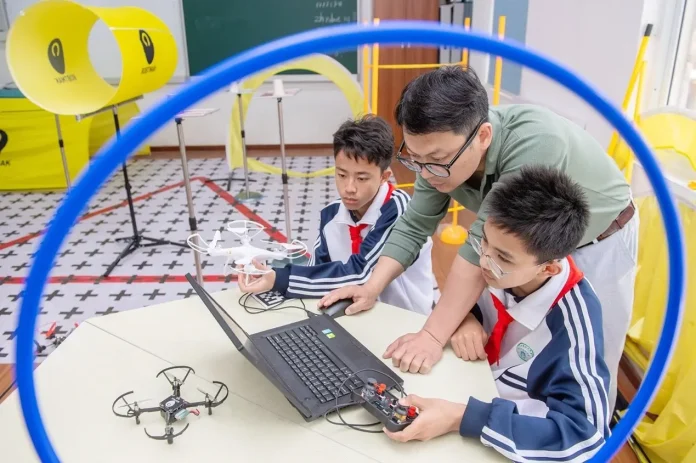
For primary and secondary schools, the plan mandates the integration of AI education into local curricula nationwide. It encourages interdisciplinary AI teaching and the incorporation of AI into after-school services. To bridge the digital divide, the government will support rural and remote schools in delivering AI courses through national digital platforms.
In Beijing, the adoption rate of AI across different school levels has already reached 87.7 percent. Li Yi, director of the Beijing Municipal Education Commission, noted that every primary and secondary student in the capital now takes at least eight class hours of AI courses per academic year, supported by an “AI education lecturer team” comprised of university experts and tech industry professionals.
The plan also addresses vocational education, promoting the integration of AI into traditional industry-related programs to train highly skilled workers capable of adapting to automated and intelligent manufacturing environments. For lifelong learning, the government pledges to provide high-quality resources, including micro-courses and micro-credentials, to help the existing workforce update their skills.
Preparing the Educators
Recognizing that a curriculum is only as effective as the teachers who deliver it, the action plan sets stringent requirements for educators. A national teacher AI literacy standard will be developed, followed by a tiered training and assessment system. Moving forward, AI knowledge will be a mandatory component of teacher qualification exams and certification processes.
The pedagogical approach emphasized by the plan focuses not just on technical skills, but on critical thinking. Yao Xiaoying, a primary school principal in Shenzhen, explained their approach: “We teach children how to use large language models to solve problems, and more importantly, how to think critically — to question whether AI’s answers are correct and verify information from multiple sources.”
Strategic Implications
China’s AI + Education Action Plan represents one of the most coordinated and comprehensive national efforts globally to adapt an entire education system for the AI era. By mandating AI literacy from primary school through doctoral studies, Beijing is ensuring a massive, continuous supply of talent capable of developing, deploying, and working alongside artificial intelligence. This systemic approach contrasts with more fragmented efforts in other nations and underscores China’s view of AI as a critical pillar of national strength. By embedding AI into the DNA of its educational infrastructure, China is laying the groundwork for sustained technological leadership in the decades to come, building on the foundation of the national ‘AI+ Education’ action plan.