
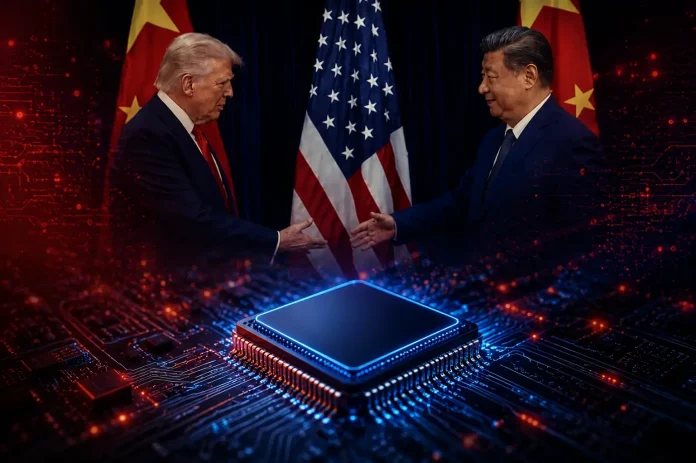
As President Donald Trump prepares for his high-stakes state visit to Beijing, the South China Morning Post argues that the U.S. administration is facing a stark reality: its semiconductor export controls have largely failed to halt China’s artificial intelligence ambitions. The summit presents a critical juncture for U.S. tech policy, forcing a reckoning between the desire to maintain technological supremacy and the undeniable evidence that current restrictions are accelerating China’s drive toward self-sufficiency.
The debate over chip controls has intensified in recent weeks, fueled by a series of high-profile developments that highlight the limitations of the current strategy. The most glaring example is the rapid rise of domestic Chinese alternatives to U.S. hardware. As we reported in April, China’s domestic chipmakers have seized 41% of the local AI market, a figure that Morgan Stanley projects will reach 76% by 2030. This shift has been driven in part by the very sanctions designed to prevent it.
The Nvidia Dilemma
The impact of these controls on U.S. industry leaders has been profound. Nvidia CEO Jensen Huang recently delivered a stark warning, stating that the export policy has backfired spectacularly. In a candid admission, Huang revealed that Nvidia now has “zero percent” market share in China for its most advanced AI chips. This loss of a crucial market not only hurts U.S. corporate revenues but also diminishes American influence over the global AI hardware ecosystem.
The situation was further complicated by the saga surrounding the H200 chip. Despite initial hopes that a modified version might be approved for export, the U.S. Commerce Department ultimately blocked the sale, citing national security concerns. This decision effectively handed the Chinese market to domestic players like Huawei, whose Ascend series chips are increasingly being adopted by major Chinese tech firms. The recent announcement that DeepSeek V4 will run on Huawei chips underscores the rapid pace of this transition.
The Strategic Debate
The failure of the current approach has sparked a fierce debate within the U.S. policy establishment. According to the report by the South China Morning Post, the Trump administration faces a stark choice: escalate the controls or relax them.
Proponents of escalation argue that the U.S. must close existing loopholes and expand restrictions to cover older, “legacy” chips, which are still crucial for many industrial and automotive applications. This approach is reflected in legislative efforts like the proposed MATCH Act, which seeks to block the sale of AI chipmaking equipment to China. However, critics warn that further tightening will only accelerate China’s push for complete self-reliance and potentially trigger retaliatory measures that could disrupt global supply chains.
On the other hand, advocates for relaxation argue that the current policy is a “horrible outcome” that harms U.S. competitiveness without achieving its primary objective. They suggest that a more targeted approach, focusing only on the most advanced, military-applicable technologies, would be more effective. This “small yard, high fence” strategy would allow U.S. companies to continue generating revenue in China, which could then be reinvested in domestic R&D to maintain the technological edge.
The View from Beijing
From Beijing’s perspective, the U.S. export controls are viewed not as a legitimate national security measure but as a deliberate attempt to contain China’s economic and technological development. This perception has fueled a massive state-backed effort to build a fully independent semiconductor supply chain. As we noted in our coverage of China’s 15th Five-Year Plan, AI and semiconductor self-sufficiency have been elevated to core national priorities.
The Chinese government has backed this ambition with unprecedented financial resources. The National Development and Reform Commission (NDRC) recently directed proceeds from ultra-long treasury bonds toward AI infrastructure, and state-backed funds are pouring billions into domestic chip startups. This influx of capital is helping Chinese companies overcome the technical hurdles associated with advanced chip manufacturing.
Furthermore, Chinese industry leaders are adopting a pragmatic approach to the technology gap. Richard Chang, the founder of Semiconductor Manufacturing International Corporation (SMIC), recently argued that measuring chip success solely by the ability to produce 3nm or 2nm nodes is a misconception. Instead, he advocated focusing on practical breakthroughs and advanced packaging techniques that can deliver high performance even with older manufacturing processes.
What to Expect at the Summit
As President Trump and President Xi Jinping prepare to meet, semiconductor export controls will undoubtedly be a central topic of discussion. However, expectations for a major breakthrough should be tempered. The U.S. is unlikely to completely abandon its containment strategy, and China is equally unlikely to halt its drive for self-sufficiency.
According to analysts cited by the South China Morning Post, the most plausible outcome is a tactical pause or a minor adjustment to the current regime. The U.S. might offer limited concessions, such as approving licenses for specific, less sensitive technologies, in exchange for Chinese cooperation on other issues, such as the proposed AI emergency communication channel.
Ultimately, the Trump-Xi summit will serve as a reality check on the limits of U.S. abilty to use technology as a policy tool in its rivalry with China. The export controls have undoubtedly slowed China’s progress in the short term, but they have also catalyzed a massive, state-directed effort to build an independent tech ecosystem. As the two leaders sit down in Beijing, they will be forced to confront the long-term consequences of this decoupling and the increasingly complex reality of the global semiconductor industry.