
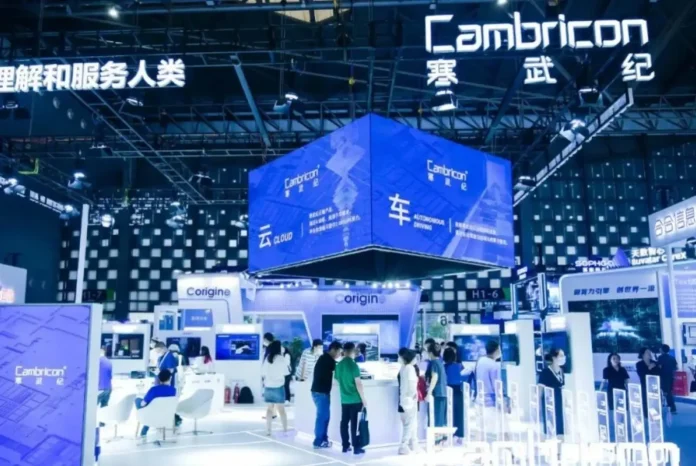
DeepSeek’s launch of its V4 model series has done more than advance the frontier of open-source AI. According to analysts at multiple Chinese brokerages, it has triggered a broad reassessment of stocks across the entire domestic AI supply chain — from the chipmakers that produce the silicon to the foundries that manufacture it, and from the model developers that will deploy it to the cloud platforms that will distribute it. The South China Morning Post’s Zhang Shidong, reporting from Shanghai on May 4, 2026, documents the investment community’s response to a model launch that has simultaneously validated China’s domestic chip ecosystem and expanded the addressable market for AI computing power.
The timing of the reassessment is significant. Cambricon Technologies, one of the primary beneficiaries identified by analysts, rose to a record high on the day of the V4 launch. The Star Market 50 Index, which tracks the largest technology stocks listed on Shanghai’s STAR Market, where Cambricon and SMIC are listed, jumped 25 percent in April to approach a five-year high. These are not incremental moves; they reflect a fundamental repricing of the expected trajectory of China’s domestic AI chip industry.
Why V4’s Chip Optimization Matters
DeepSeek V4’s most strategically significant technical characteristic is not its benchmark performance, though that is impressive, but its optimization for domestically produced chips. The model was designed from the outset to run efficiently on Chinese silicon, and DeepSeek has been explicit about its compatibility with chips from Cambricon, Moore Threads, and Huawei’s HiSilicon division.
This optimization matters for several reasons. First, it validates the commercial viability of domestic chips for frontier AI workloads. The persistent question in China’s AI chip industry has been whether domestic silicon can support the most demanding applications or remain confined to lower-performance inference tasks. V4’s performance on domestic chips, which DeepSeek describes as competitive with OpenAI and Anthropic’s best systems, provides a definitive answer.
Second, it creates a self-reinforcing dynamic between model development and chip development. As DeepSeek and other Chinese AI labs optimize their models for domestic chips, the chips become more valuable. As the chips become more valuable, more investment flows into their development. As more investment flows into chip development, the chips improve. This virtuous cycle is exactly what China’s domestic chip industry needs to close the remaining gap with Nvidia’s CUDA ecosystem.
Third, it reinforces China’s technology stack under sanctions. US export controls have effectively eliminated Nvidia from China’s AI chip market, creating an urgent need for domestic alternatives. V4’s optimization for domestic chips accelerates the adoption of those alternatives by demonstrating that frontier performance is achievable without Nvidia hardware.
The Beneficiary Map
Analysts at Chinese brokerages have identified a layered set of beneficiaries from V4’s launch, spanning the full AI supply chain.
Chipmakers are the most direct beneficiaries. Cambricon Technologies, which designs AI accelerators for cloud and edge inference, is the most frequently cited name. The company posted its first-ever profit in early 2026, a milestone that reflected both growing demand and improving manufacturing yields, and its stock has continued to rise as V4 adoption drives incremental demand. Moore Threads Technology, which focuses on GPU-class chips for AI training and inference, is another primary beneficiary. Hygon Information Technology and MetaX Integrated Circuits round out the list of chipmakers that analysts expect to see increased orders.
Foundry operators benefit from the increased demand for chip manufacturing that V4 adoption will generate. SMIC (Semiconductor Manufacturing International Corp) and Hua Hong Semiconductor are the two most prominent names. SMIC, China’s largest contract chipmaker, manufactures chips for Cambricon and other domestic AI chip designers. SMIC and Hua Hong posted record revenue in Q1 2026, and the V4 launch is expected to sustain that momentum.
AI model companies benefit from the lower inference costs enabled by V4’s domestic chip optimization. Su Lingyao, an analyst at BOC International, notes that “DeepSeek’s V4 has lowered the threshold for using high-performance AI models and will offer more affordable AI capabilities to small and medium-sized enterprises or even individuals.” MiniMax and Knowledge Atlas Technology (Zhipu AI) are both positioned to benefit from a broader wave of commercial AI adoption enabled by V4’s cost reductions.
The Market Size Projection
The investment case for China’s domestic AI chip industry is underpinned by a market size projection that, if accurate, represents one of the largest growth opportunities in the global technology sector. Guotai Haitong Securities estimates that China’s AI chip market will rise from RMB 142.5 billion ($19.6 billion) in 2024 to RMB 1.34 trillion ($196.2 billion) in 2029, a compound annual growth rate of 54 percent over five years.
Projected growth not only reflects growth from existing AI application. There is also an expected expansion of AI into new domains, such as manufacturing, healthcare, autonomous vehicles, and consumer devices, that V4’s cost reduction and domestic chip optimization make more economically viable.
Li Kefu, an analyst at Sinolink Securities, frames the significance of V4’s domestic chip collaboration in systemic terms: “DeepSeek’s collaboration with domestic chipmakers is of great significance in driving the coordinated development of hardware and software for large language models and speeding up self-controlled computing power domestically.” The phrase “self-controlled computing power” is a direct reference to China’s strategic goal of achieving semiconductor self-sufficiency, a goal that V4’s launch has materially advanced.
DeepSeek’s Funding Ambitions
The V4 launch has also intensified interest in DeepSeek’s own financial trajectory. The Hangzhou-based startup, which has operated without external funding since its founding, is reportedly in talks with Tencent Holdings and Alibaba for its first external funding round. The terms and valuation of any such deal have not been disclosed, but the involvement of China’s two largest technology companies would signal strategic validation beyond financial support.
DeepSeek’s decision to seek external funding, if confirmed, would mark a significant shift in the company’s posture. Its earlier releases generated global attention precisely because they demonstrated that frontier AI performance was achievable with relatively modest resources. A funding round from Tencent and Alibaba would provide the capital to scale infrastructure, expand the team, and develop the next generation of models, but it would also change the company’s relationship with the broader Chinese AI ecosystem in ways that are difficult to predict.
Morgan Stanley’s Corroborating View
Morgan Stanley’s analysis of Chinese AI stocks, published the same day as the SCMP’s V4 chip demand story, provides independent corroboration of the domestic chip thesis. The bank describes Chinese models as “efficient, delivering performances similar to US peers at only 15 to 20 per cent of inference costs,” a characterization that is consistent with DeepSeek V4’s pricing of $1.74 per million tokens.
Morgan Stanley’s forecast of $1.25 to $1.75 billion in passive inflows into Hong Kong tech stocks following the Hang Seng Tech Index inclusion of MiniMax and Zhipu is partly predicated on the same thesis: that Chinese AI model companies are undervalued relative to their growth prospects, and that the V4 launch has strengthened the fundamental case for that valuation gap to close.
(Related: VeriSilicon Books $1.1 Billion in AI Chip Orders as Q1 Revenue Doubles | Chinese Tech Giants Scramble for Huawei Ascend Chips as DeepSeek V4 Triggers Supply Crunch)