
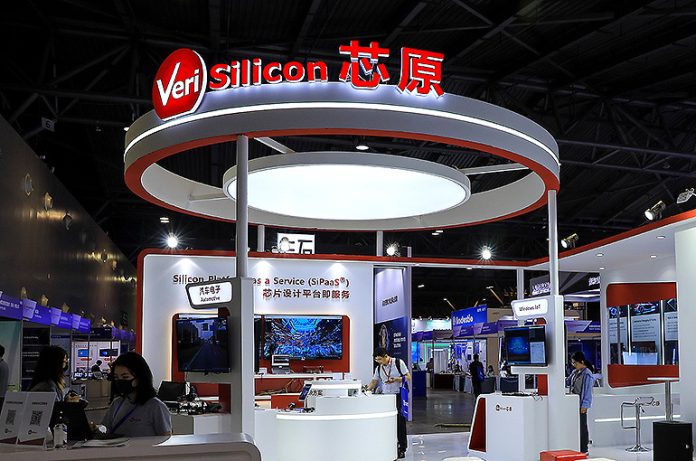
VeriSilicon Microelectronics, the Shanghai-listed chip design services company that positions itself as a “Silicon Platform as a Service” provider, delivered a set of first-quarter 2026 results that underscore the extraordinary pace of China’s domestic AI chip buildout. DigiTimes reports that the company’s revenue for the quarter reached RMB 836 million ($115 million), up 114.47 percent year-on-year, and the company disclosed a year-to-date order book of RMB 8.24 billion (approximately $1.13 billion), of which 91.37 percent is tied to AI computing power applications.
The results, released on April 29 and reported by Digitimes Asia on May 4, sent VeriSilicon’s stock up 20 percent on the day of the announcement. The market reaction reflects not just the headline revenue growth but the composition of the order book, which signals that VeriSilicon has successfully repositioned itself as a primary beneficiary of China’s AI chip localization drive.
Revenue Breakdown: Volume Production Leads the Surge
VeriSilicon’s business model spans three revenue lines: one-stop chip customization (design services through to volume production), semiconductor IP licensing, and standalone chip design services. All three grew sharply in Q1 2026, but the standout performer was volume production, the segment where VeriSilicon manufactures chips it has designed for customers.
Volume production revenue reached RMB 467 million in Q1, up 219.93 percent year-on-year, and now accounts for more than half of the company’s total revenue. This is a significant structural shift. Historically, VeriSilicon derived most of its revenue from design services and IP licensing, relatively capital-light activities with steady but modest growth. The surge in volume production revenue reflects the transition of AI chip projects from design phase to mass manufacturing, a transition that typically takes two to three years from initial engagement.
Chip design services revenue grew 57.60 percent to RMB 193 million, and semiconductor IP licensing royalty income rose 52.97 percent to RMB 143 million. The overall one-stop chip customization business, which bundles design, verification, and production, grew 145.90 percent year-on-year, confirming that customers are increasingly choosing VeriSilicon as a full-service partner rather than engaging it for individual services.
The Order Book: A Window Into China’s AI Infrastructure Pipeline
The most strategically significant disclosure in VeriSilicon’s Q1 results is the order book. As of April 29, 2026, the company had signed RMB 8.24 billion in new orders year-to-date, a figure that represents roughly 2.5 times its total 2025 revenue and provides visibility into its revenue trajectory for the next twelve months.
The composition of that order book is telling. AI computing power-related orders account for 91.37 percent of the total, and orders for volume production services alone exceeded RMB 3 billion. Data processing applications, which include cloud-side AI ASICs and related IP, account for more than 56 percent of the total order book. The company notes that over 90 percent of its orders are expected to convert to revenue within one year, providing unusually strong near-term revenue visibility for a company in the semiconductor design services space.
VeriSilicon shipped 109 chip models under its own design service projects in Q1 2026 and has 50 existing design projects awaiting mass production, a pipeline that will sustain volume-production revenue growth through 2026 and into 2027. The company currently has 99 ongoing chip design projects, up 10 from the prior year, with advanced node projects (7nm and below) accounting for 26.26 percent of the total.
Why VeriSilicon Is Winning
VeriSilicon’s business model is well-suited to the current phase of China’s AI chip development. Most Chinese AI chip startups lack the internal resources to manage the full chip development lifecycle, from architecture design through physical implementation, verification, and volume production. VeriSilicon provides that full-stack capability, allowing customers to focus on architecture and application-layer differentiation while outsourcing the execution-intensive work of turning a design into a manufactured chip.
This model is particularly valuable for the wave of AI ASIC startups that have emerged in China over the past three years. Companies designing custom inference chips for cloud providers, edge AI applications, and autonomous systems need a trusted manufacturing partner with deep experience in advanced nodes. VeriSilicon’s relationships with TSMC, SMIC, and other foundries, combined with its IP portfolio and design methodology, make it a natural choice.
The company’s IP licensing business also benefits from the AI chip boom. VeriSilicon’s portfolio includes GPU cores, neural processing units, display processors, and multimedia IP blocks that chip designers embed in their custom designs. As the number of AI chip projects in China multiplies, the demand for licensed IP grows proportionally, a recurring revenue stream that requires minimal incremental investment.
The Profitability Question
The one shadow on VeriSilicon’s otherwise impressive Q1 results is the widening net loss. The company reported an attributable net loss of RMB 340.8 million in Q1 2026, compared with a loss of RMB 220.3 million in the prior-year period. The deterioration reflects heavy R&D spending as the company invests in next-generation IP and design capabilities to maintain its technology lead.
This is a deliberate strategic choice rather than a sign of operational weakness. VeriSilicon is investing in the capabilities it will need to serve the next generation of AI chip projects, particularly those targeting 5nm and below process nodes, where the complexity of physical implementation increases sharply and the value of experienced design services partners is highest. The company’s management has indicated that profitability improvement is expected as volume production revenue continues to scale and R&D spending as a percentage of revenue normalizes.
The pattern is familiar in the semiconductor services industry: companies that invest aggressively in capability during periods of rapid demand growth tend to emerge with stronger competitive positions than those that prioritize near-term profitability. VeriSilicon’s order book suggests the investment is generating results.
Context: China’s AI Chip Localization Drive
VeriSilicon’s results are best understood in the context of China’s broader AI chip localization effort. US export controls have effectively cut off Chinese AI companies from Nvidia’s most capable chips, creating a captive market for domestic alternatives. The companies filling that gap, such as Huawei, Cambricon, Moore Threads, and a growing ecosystem of ASIC startups, all need design and manufacturing services.
DeepSeek V4’s optimization for domestic chips has further accelerated this dynamic by demonstrating that frontier AI performance is achievable on Chinese silicon. As more AI labs and cloud providers commit to domestic chip roadmaps, the demand for the design and manufacturing services that VeriSilicon provides will continue to grow. The company’s RMB 8.24 billion order book is an early but concrete measure of that demand.
China’s AI chip market is projected to reach RMB 1.34 trillion ($196 billion) by 2029, growing at a compound annual rate of 54 percent. VeriSilicon, with its full-stack design services model and rapidly scaling order book, is positioned to capture a meaningful share of that growth, provided it can continue to invest in the advanced node capabilities that the next generation of AI chips will require.
(Related: DeepSeek V4’s Chip Demand — Who Stands to Benefit Most? | Chinese Chip Giants SMIC and Hua Hong Post Record Revenue as AI Boom Overrides US Sanctions)