
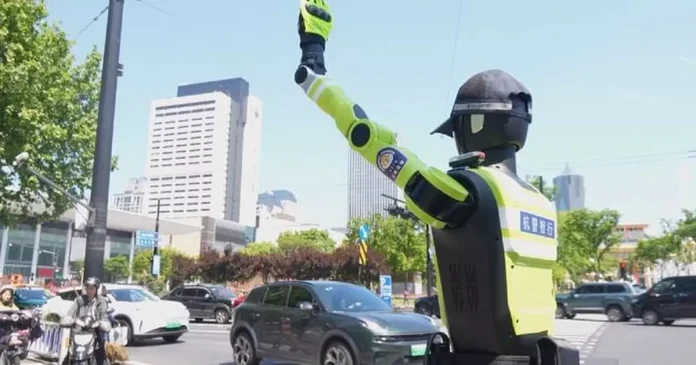
The future of municipal law enforcement has arrived in eastern China. During the busy May Day holiday, the city of Hangzhou deployed the country’s first formally organized squad of humanoid robot traffic police, marking a significant milestone in the real-world application of embodied artificial intelligence.
The deployment, covered extensively by Xinhua and state outlet Global Times, features a specialized unit of intelligent robots designated as “Hangxing No. 1.” These machines are not merely experimental prototypes confined to a laboratory; they are actively managing traffic flow, assisting pedestrians, and enforcing road regulations at some of the city’s most congested intersections during one of China’s peak travel periods.
Advanced Sensors and Autonomous Operation
The Hangxing No. 1 robots are equipped with a sophisticated array of sensors that allow them to navigate complex urban environments. According to technical details shared on social media, the robots use advanced LiDAR (Light Detection and Ranging) systems, high-resolution cameras, and complex computer vision algorithms to process their surroundings in real time.
This sensor suite enables the robots to identify traffic light changes, monitor vehicle speeds, and detect pedestrian movements with high precision. Unlike stationary traffic cameras, the humanoid form factor allows these robots to physically position themselves in intersections, using articulated arms to direct traffic and issue visual commands that human drivers and pedestrians instinctively understand.
The deployment in Hangzhou represents a leap forward from previous humanoid robots entering home cleaning services in Shenzhen and Beijing. While domestic robots operate in relatively controlled indoor environments, the Hangxing No. 1 must contend with the unpredictable dynamics of a bustling city street.
Public Reception and Municipal Strategy
The introduction of robot traffic police has generated significant public interest, with crowds frequently gathering to observe and photograph the machines in action. For Hangzhou, a city known as a major tech hub and the headquarters of Alibaba, the deployment serves both practical and symbolic purposes.
In practice, the robots alleviate the burden on human traffic officers during the grueling May Day holiday, when tourist influxes strain municipal resources to the limit. Symbolically, the initiative reinforces Hangzhou’s reputation as a pioneer in smart city governance and AI integration.
The move also aligns with broader national objectives. As highlighted in a recent MERICS report on China’s robotics industry, Beijing is aggressively pushing for the commercialization and widespread adoption of embodied AI. The government aims to establish a robust domestic ecosystem for humanoid robots, reduce reliance on foreign technology, and position China as a global leader in the sector.
The Future of Automated Law Enforcement
While the current deployment is limited to traffic management, the success of the Hangxing No. 1 squad could pave the way for broader applications of humanoid robots in public security and municipal services. The ability of these machines to operate continuously without fatigue, coupled with their capacity to process vast amounts of data instantaneously, makes them attractive assets for city administrators.
However, integrating AI into law enforcement also raises questions about accountability, algorithmic bias, and public trust. As these robots become more autonomous and capable of making complex decisions, municipal governments will need to establish clear regulatory frameworks to govern their use.
For now, the robot traffic police of Hangzhou stand as a highly visible testament to China’s rapid progress in applied robotics, offering a glimpse into a future where human-machine collaboration is a routine aspect of urban life.
Technical Specifications and Operational Capabilities
The Hangxing No. 1 is equipped with high-definition cameras, LiDAR sensors, and high-performance visual recognition algorithms. The robots operate for eight to nine hours per day on swappable batteries, freeing human officers from the repetitive tasks of issuing warnings and providing verbal guidance to pedestrians.
The violation detection system uses visual recognition algorithms to identify non-motorized vehicles stopping beyond the designated line, cyclists riding without helmets, and pedestrians straying into motor vehicle lanes. After issuing three verbal warnings, the robot automatically logs the violation to the traffic police bureau’s early warning center. The robots are also linked in real time with traffic signal control systems and can execute eight types of traffic commands approved by China’s Ministry of Public Security, synchronizing their gestures with traffic light changes.
Prior to the May Day deployment, the Hangxing No. 1 units had participated in traffic management support for city marathons, providing valuable operational data before being deployed in this high-stakes public safety role. Public reaction has been enthusiastic, with netizens praising the deployment and calling for a nationwide rollout.