
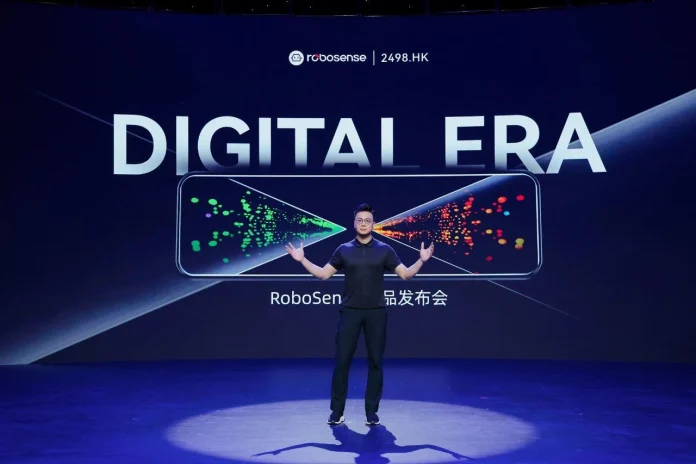
RoboSense, China’s largest lidar manufacturer by market share, is building its first overseas production facility in Southeast Asia, according to a report published by Nikkei Asia. The plant is intended to serve global customers, particularly automotive OEMs in Europe, Japan, and the United States, who have expressed concern about the geopolitical risks of sourcing critical sensor components exclusively from mainland China. The move reflects a broader pattern among Chinese hardware companies: building manufacturing capacity outside China to preserve market access in a world where US-China trade tensions are reshaping procurement decisions.
RoboSense went public on the Hong Kong Stock Exchange in January 2024, raising approximately $243 million in its IPO. The company is the dominant supplier of lidar sensors to China’s autonomous driving industry, with customers including Xpeng, Li Auto, and a range of robotaxi operators. Its sensors are also used in industrial automation, logistics robots, and smart infrastructure applications. The decision to build overseas is not a sign of weakness in its home market, RoboSense’s domestic business remains strong but a strategic hedge against the risk that its products could be caught in escalating trade restrictions.
(Related: RoboSense Unveils Next-Gen Solid-State Lidar as China Dominates Autonomous Driving Sensors)
Why Southeast Asia
The choice of Southeast Asia as the location for RoboSense’s first overseas plant is consistent with a pattern that has emerged across Chinese manufacturing over the past three years. Vietnam, Malaysia, Thailand, and Indonesia have all attracted significant Chinese investment as companies seek to establish production capacity that is geographically and legally distinct from mainland China. For semiconductor and hardware companies in particular, Southeast Asian manufacturing facilities can serve as a buffer against US export controls that target Chinese-origin goods.
RoboSense has not disclosed the specific country or the scale of the planned facility. Nikkei Asia reported that the plant is intended to serve customers who require non-China-origin components as a condition of their supply chain compliance programs. This is a requirement that has become increasingly common among European and Japanese automotive OEMs, which are under pressure from their own governments and investors to reduce supply chain concentration in China.
(Related: China Reroutes Chip Tool Imports Through Southeast Asia as US Controls Tighten)
The lidar market is a particularly sensitive area for US-China trade policy because lidar sensors are dual-use technologies — they have both commercial and military applications. Hesai Technology, RoboSense’s main domestic rival, was added to the US Department of Defense’s list of companies allegedly working with the Chinese military in January 2025, a designation that has complicated its efforts to expand in Western markets. RoboSense has not been similarly designated, but the risk that it could be is a factor in its decision to establish overseas production capacity.
The Lidar Market’s Global Dynamics
China now dominates the global lidar market for automotive applications. RoboSense and Hesai together account for a majority of global lidar shipments to the automotive sector, having displaced earlier market leaders including Velodyne and Luminar. The dominance is built on a combination of manufacturing scale, cost efficiency, and rapid product iteration, the same advantages that Chinese companies have deployed in solar panels, batteries, and consumer electronics.
For Western autonomous driving companies, the dominance of Chinese lidar suppliers creates a genuine dilemma. The sensors are technically competitive and significantly cheaper than alternatives from US or European suppliers, but sourcing them from Chinese companies creates supply chain concentration risk and, in some cases, regulatory exposure. RoboSense’s overseas plant is designed to address exactly this concern: by manufacturing in Southeast Asia, the company can offer its customers a supply chain that is geographically diversified even if the underlying technology and intellectual property remain Chinese.
The plant also positions RoboSense to serve the growing autonomous-driving market in Southeast Asia. Countries including Singapore, Thailand, and Indonesia are investing in autonomous vehicle infrastructure, and a local manufacturing presence would give RoboSense a competitive advantage in those markets over suppliers that ship from China.
Implications for the Autonomous Driving Supply Chain
The broader significance of RoboSense’s overseas expansion is what it signals about the future of the autonomous driving supply chain. Chinese companies are not retreating from global markets amid geopolitical pressure, they are adapting their manufacturing and supply chain strategies to preserve access to those markets. The same pattern is visible in the EV battery industry, where CATL and BYD have both announced overseas manufacturing investments in Europe and Southeast Asia, and in the solar panel industry, where Chinese manufacturers have built capacity in Vietnam and Cambodia to avoid US tariffs.
For the autonomous driving industry specifically, the implication is that Chinese sensor technology will remain a central part of the global supply chain for the foreseeable future, regardless of how US-China trade tensions evolve. The question is not whether Chinese lidar will be used in autonomous vehicles worldwide, but where it will be manufactured and under what regulatory framework.