
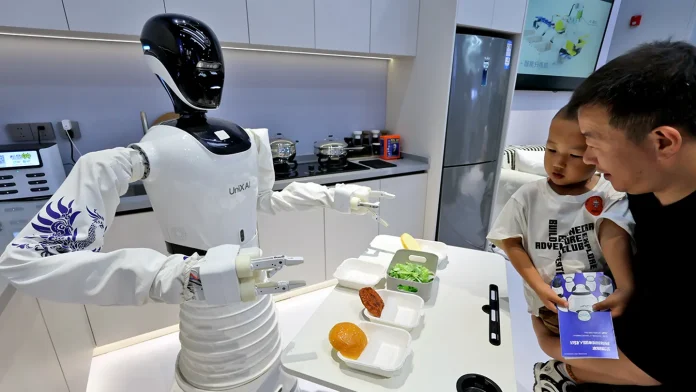
The rapid rise of Chinese humanoid robotics companies, often portrayed as a triumph of nimble startup innovation, is actually the result of a massive, state-orchestrated industrial policy. This is the core argument of a critical opinion piece published in Nikkei Asia by Christopher Nye, a nonresident fellow at the Jamestown Foundation. The analysis challenges the prevailing narrative about companies like Unitree Robotics, arguing that their success is engineered by a “multilayered cultivation architecture” that floods global markets with low-cost platforms before Western competitors can react.
Unitree recently captured global attention by filing for a $610 million IPO on the Shanghai Stock Exchange and launching a $7,000 humanoid robot on AliExpress with free international shipping. However, Nye points out that Unitree’s own prospectus reveals the heavy hand of the state: the company received $11 million in tax incentives in the first nine months of 2025 alone, alongside nearly $5 million in direct government grants since 2022. Unitree also holds the coveted “little giant” designation, a state certification that unlocks cash rewards, preferential procurement, and low-interest credit.
(Related: Unitree Robotics Files for $610 Million IPO, Revealing a Rare Profitable Humanoid Robot Business)
The Gradient Cultivation System
The Nikkei Asia piece details how Beijing’s “gradient cultivation system” operates across multiple levels of government. In the first quarter of 2026, the embodied intelligence sector saw 210 financing events totaling over $4 billion, heavily concentrated in Shenzhen, Beijing, Shanghai, and Hangzhou. This capital is largely driven by government-backed investment funds that absorb early-stage risks private venture capital would typically avoid. For example, Hefei deployed state funds to participate in a $200 million round for LimX Dynamics, while Shanghai is targeting a $7 billion core embodied AI industry by 2027, partly by pairing domestic state funds with sovereign wealth from the Global South.
This state support extends beyond capital. The Chinese government is actively working to lock in these advantages by defining industry standards. Late last year, the Ministry of Industry and Information Technology established a National Humanoid Robot Standardization Technical Committee, appointing Unitree’s founder, Wang Xingxing, as vice chairman. By setting domestic standards within the world’s largest robotics market, China aims to project those parameters internationally, creating barriers to entry for foreign competitors.
A Portfolio Bet on Global Dominance
Nye acknowledges that the system is “extravagantly wasteful,” predicting that most of the 100-plus humanoid companies currently operating in China will fail. However, he argues that Beijing treats this as a portfolio bet, willing to absorb massive losses to produce a few dominant global champions—a strategy successfully employed in the electric vehicle sector with companies like BYD and CATL.
The analysis concludes with a stark warning for Western policymakers: current trade tools like tariffs and entity lists are insufficient because they target products or individual companies after they have achieved scale, rather than addressing the institutional infrastructure that produces them. “A Japanese or European robotics startup competing against this system faces an opponent whose cost structure, capital access, and regulatory environment have been engineered by the state from the outset,” Nye writes. The $7,000 humanoid is impressive engineering, but it is ultimately the product of a machine designed to secure supply chain dominance.