
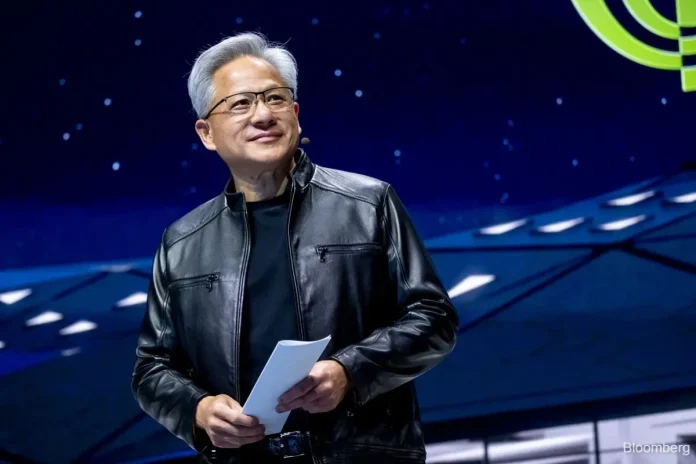
Nvidia CEO Jensen Huang delivered an unusually sharp public critique of US chip export controls in a recent appearance on the Dwarkesh Patel podcast, calling the rationale behind the policy “extremely stupid” and describing the mindset that supports it as a “loser’s mentality.” The remarks, which have been widely circulated in both US and Chinese technology media, represent the most direct public statement Huang has made against export controls, a policy that has significantly affected Nvidia’s ability to sell its most advanced chips in China, its largest market outside the United States.
What Huang Actually Said
The core of Huang’s argument is about ecosystem fragmentation. His exact words, as reported by Biggo Finance’: “We want to ensure that AI developers worldwide are building on the U.S. technology stack so that contributions and advancements in AI, especially in the open-source domain, flow back into the U.S. ecosystem. Creating two ecosystems is an extremely stupid thing to do: one open-source system that runs only on a foreign technology stack, and another closed system on the U.S. technology stack. That would be a very bad outcome for the United States.”
When podcast host Dwarkesh Patel suggested that allowing Nvidia to sell chips in China could create powerful competitors, analogous to how Tesla or the iPhone faced competition from Chinese imitators, Huang pushed back directly: “As you know, our market share is growing, not shrinking. Your argument that participating in the Chinese market means you’ll lose it doesn’t hold water… You’re not talking to a loser.”
Huang also argued that China can develop advanced AI regardless of whether it has access to Nvidia chips because the country already has sufficient computing resources to develop competitive models by “stacking compute.” This argument, that export controls do not prevent Chinese AI development but merely redirect it, is one that critics of the export control policy have made for years, but it carries particular weight coming from the CEO of the company whose chips are being restricted.
The Anthropic Admission
In the same interview, Huang addressed a question about Anthropic’s use of Google TPU and Amazon Trainium chips rather than Nvidia hardware. He admitted that this was the result of an early strategic mistake: “At the beginning of Anthropic, NVIDIA didn’t have the ability to write a multi-billion dollar equity check like Google and AWS did: that was my mistake.” He said he failed to understand at the time that venture capital firms would not invest such massive sums in an AI lab, forcing Anthropic to turn to cloud providers for computing resources.
Huang was careful to frame Anthropic’s non-Nvidia chip usage as an exception rather than a trend: “Without Anthropic, TPU and Trainium would have zero growth, 100% of it is Anthropic’s contribution.” This is a significant claim, it asserts that Google’s TPU and Amazon’s Trainium chips have essentially no adoption outside of Anthropic, and that Nvidia’s dominance in the AI chip market is otherwise unchallenged. Whether this claim is accurate is difficult to verify independently, but it reflects Huang’s confidence in Nvidia’s competitive position.
Why This Matters for the US-China AI Competition
Huang’s remarks are significant for several reasons beyond their rhetorical force. First, they represent a direct challenge to the bipartisan consensus in Washington that chip export controls are an effective tool for slowing Chinese AI development. Huang is arguing, from a position of deep industry knowledge, that the policy is counterproductive, harming US companies without meaningfully constraining Chinese AI progress.
Second, the remarks highlight the tension between national security objectives and commercial interests in US technology policy. Nvidia has developed China-specific chips, the H20, L20, and L2, that comply with export control requirements but deliver lower performance than the company’s flagship products. These chips represent a significant revenue stream for Nvidia in China, and the company has a strong commercial interest in maintaining access to the Chinese market. Huang’s public advocacy against export controls is, in part, a business argument dressed in strategic language.
Third, the remarks are likely to be used in China as evidence that US export controls are driven by protectionism rather than genuine security concerns. The Chinese government and Chinese technology companies have consistently argued that US chip restrictions are an attempt to maintain US technological dominance rather than a response to specific security threats. Huang’s “loser’s mentality” framing aligns closely with this narrative, even if that was not his intention.
The Export Control Policy Debate in Washington
Huang’s remarks arrive at a moment when the US export control policy toward China is under active review. The Biden administration’s October 2023 and October 2024 export control rules significantly expanded the restrictions on advanced chip exports to China, and the Trump administration has been evaluating whether to maintain, expand, or modify those rules. The debate within the US government involves competing considerations: the national security argument for restricting Chinese access to advanced AI chips, the commercial argument for maintaining US companies’ access to the Chinese market, and the strategic argument about whether restrictions actually slow Chinese AI development.
Huang’s intervention in this debate, as the CEO of the company most directly affected by the restrictions, is likely to influence the policy discussion, even if it does not change the outcome. His argument that ecosystem fragmentation is the greater strategic risk resonates with a school of thought in Washington that prioritizes maintaining US technological standards as the global default over restricting Chinese access to specific hardware. The EastFrontier coverage of China’s AI supply chain and the NeurIPS researcher ban controversy both illuminate the broader context in which Huang’s remarks land: a US-China technology relationship that is simultaneously deeply interdependent and increasingly adversarial, in which every policy decision involves trade-offs between security, commerce, and strategic positioning.