
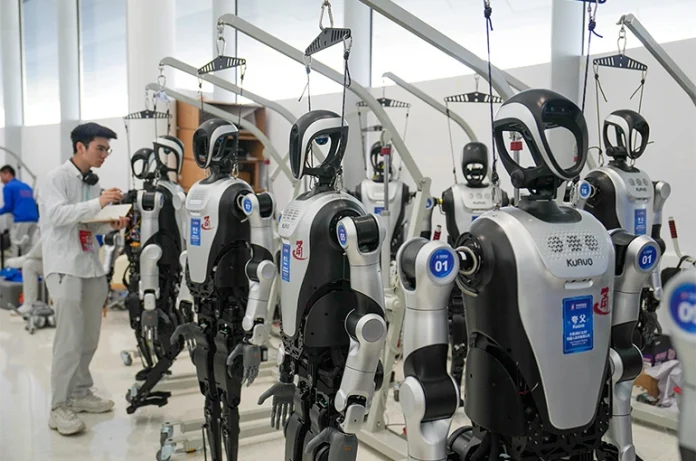
The rapid expansion of China’s embodied intelligence sector has created a massive talent shortage, transforming humanoid robot engineering into one of the country’s most lucrative and sought-after professions. According to a recent report by Liepin’s Big Data Research Institute, cited by The Asia Business Daily, the average annual salary in the humanoid robot sector has reached 406,100 yuan (approximately $56,000), significantly outpacing traditional engineering roles and establishing it as a new “golden job” in the domestic tech industry.
This surge in compensation reflects the intense competition among Chinese technology companies, startups, and research institutions to secure top-tier talent capable of developing next-generation robotic systems. The data reveals a staggering 215.8 percent increase in new job postings specifically within the humanoid robot sector over the past year, highlighting the explosive growth and strategic prioritization of this emerging field.
The Talent Crunch in Embodied Intelligence
The broader robotics sector in China is experiencing a similar, albeit slightly less extreme, boom. New jobs across the entire robotics industry increased by 75.26 percent year-over-year, with the average annual salary reaching 328,000 yuan (approximately $45,000). However, the premium placed on expertise in humanoid robotics—which requires a complex synthesis of mechanical engineering, artificial intelligence, computer vision, and control systems—is evident in the significantly higher compensation packages offered to specialists in this niche.
To put these figures into perspective, the average monthly salary for Chinese college graduates six months after graduation in 2024 was just 6,199 yuan (approximately $850 per month, or $10,200 annually). The stark contrast underscores the immense value placed on advanced technical skills in a market where demand vastly outstrips supply. Industry estimates suggest that demand for robotics technical personnel currently exceeds supply by more than 5 times, creating a highly favorable environment for qualified engineers.
The talent crunch is exacerbated by the broader shortage of artificial intelligence professionals in China. The country currently faces a deficit of more than 5 million AI specialists, a gap that severely constrains the development and deployment of advanced technologies across all sectors. In the highly specialized field of embodied intelligence, where AI algorithms must be seamlessly integrated with physical hardware, the scarcity of qualified talent is even more acute.
The Push for Mass Production and Investment
The intense competition for talent is driven by the rapid commercialization of humanoid robots. Industry analysts project that the global robot market will reach nearly $30 billion in 2026, a year widely dubbed the “first year of mass production” for humanoid machines. The Chinese market alone is expected to exceed $11 billion this year, reflecting the massive scale of domestic investment and deployment.
This growth is fueled by a surge of capital flowing into the sector. According to data from ITjuzi, as of April 21, 2026, there had been 151 investments in the embodied intelligence sector, including 18 large-scale projects with investments exceeding 1 billion yuan. This influx of funding has enabled startups and established tech giants alike to aggressively recruit top talent, driving up salaries and intensifying the competition for experienced engineers.
The sector’s strategic importance is also reflected in the involvement of major state-owned enterprises and government initiatives. The recent opening of the Beijing Humanoid Robot Industry Base and significant procurement contracts from entities like the State Grid demonstrate a coordinated effort to accelerate the development and adoption of domestic robotic technologies. This state-backed momentum further amplifies the demand for skilled professionals capable of executing these ambitious projects.
(Related: Beijing Hosts 3rd China Embodied Intelligence and Humanoid Robot Industry Conference)
Educational Reforms to Bridge the Gap
Recognizing the critical bottleneck posed by the talent shortage, the Chinese government and educational institutions are taking proactive steps to cultivate the next generation of robotics engineers. The Ministry of Education has introduced new academic majors specifically focused on “embodied intelligence” and “brain-computer interfaces,” aiming to align university curricula with the evolving needs of the technology sector.
Nine leading universities, including Beihang University, Shanghai Jiao Tong University, and Zhejiang University, have already launched dedicated departments or specialized programs in these fields. Furthermore, relevant majors are being established at vocational colleges and technical education institutions to ensure a steady pipeline of skilled technicians capable of manufacturing, maintaining, and operating advanced robotic systems.
These educational reforms are crucial for the long-term sustainability of China’s robotics industry. While the current “golden job” status of humanoid robot engineers reflects a temporary market imbalance, the strategic goal is to build a robust and self-sustaining talent ecosystem. By integrating cutting-edge AI and robotics education into the national curriculum, China aims to overcome the current talent crunch and secure its position as a global leader in the era of embodied intelligence.