
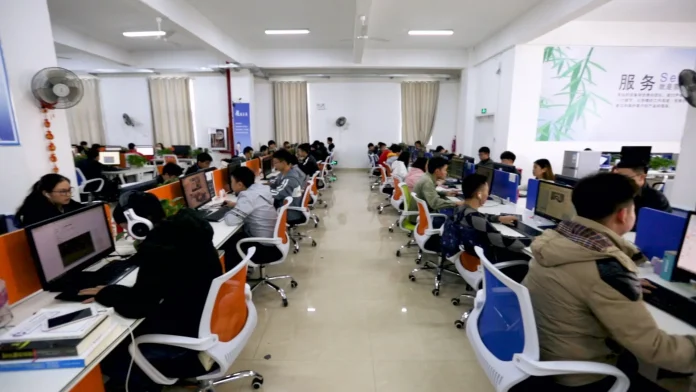
As China accelerates its race to global AI leadership, much of the spotlight has focused on breakthrough chips, sophisticated AI models, and high-profile tech hubs in Beijing, Shenzhen, and Hangzhou. Yet, behind this fast-evolving landscape lies a less glamorous but critical foundation: massive data-labeling centers staffed predominantly by rural workers in China’s inland provinces. These centers, often situated in poverty-alleviation relocation communities, are the human cogs in the AI machine, providing the annotated data essential for training and refining AI systems.
A recent in-depth report by Sixth Tone sheds light on this overlooked workforce and the innovative “inland-sourcing” model that has become a backbone of China’s AI ecosystem. This article draws on these findings to explore how these data labeling operations function, their socio-economic context, and what they reveal about China’s AI employment narrative.
The Inland-Sourcing Model: A Strategic Shift
Since around 2018, major Chinese tech companies have been relocating their data-labeling operations from expensive coastal cities like Beijing, Hangzhou, and Shenzhen to inland provinces, including Shanxi, Shaanxi, Xinjiang, Guizhou, and Henan. This strategic shift, dubbed the “inland-sourcing model,” aims primarily to reduce labor costs and address data security concerns amid fears of leaks in more exposed tech hubs.
The relocation centers are often set up in “relocation communities”—government-built settlements designed as part of China’s poverty alleviation campaigns to resettle rural populations from inhospitable regions into more stable living environments. One pioneering example is “B-Tech,” a major anonymized tech company that in 2018 opened its first data-labeling center in a remote valley community. The company negotiated to use rent-free spaces for three years and received subsidies, with a hiring priority for “women in difficult circumstances,” mainly young mothers and middle-aged women with childcare responsibilities.
This approach dovetails with local governments’ enthusiasm to attract data companies. The data industry is seen as a low-barrier, labor-intensive sector resembling traditional factory work, making it an appealing avenue for job creation in economically lagging inland regions. The government’s support includes daily training subsidies of around 50 yuan ($7) to keep workers ready during slow periods and poverty-alleviation workshop subsidies reaching up to 500 yuan when labeling orders faltered.
The Workforce: Women at the Frontline of China’s AI
The workforce in these inland data-labeling centers is overwhelmingly female, particularly young mothers and middle-aged women tasked with childcare. For many, these jobs offer a rare source of stable income close to home, an important factor in social stability and poverty reduction.
The labeling work itself requires meticulous attention to detail but often involves repetitive tasks such as image annotation for autonomous vehicles, audio slicing, and scoring for reinforcement learning with human feedback (RLHF). Despite the seemingly mundane nature of the work, the centers report accuracy rates of 97-98%—surpassing those of external crowdsourcing platforms, according to a project manager at a major tech firm.
Interestingly, the centers rely heavily on local managers who maintain intimate knowledge of their workers’ circumstances and capabilities. This human insight, the manager noted, is “far more accurate and effective than algorithms, and much cheaper,” underscoring the enduring value of human judgment in AI’s development pipeline.
A Counter-Narrative to AI Job Displacement
This model complicates dominant narratives that portray AI primarily as a job destroyer. Instead, China’s inland data-labeling centers represent a form of “digital-economy employment” and “AI-related job creation” actively promoted by government policy. The reality is more nuanced: AI here is creating factory-like jobs, not eliminating them.
This is a crucial distinction highlighted in government reports and reflected on the ground. While AI automates and enhances many processes, it simultaneously generates demand for vast amounts of labeled data, a need met by human labor in these centers. This phenomenon contrasts sharply with anxieties voiced elsewhere about AI displacing workers en masse.
However, challenges remain. Labeling orders arrive in waves, with surges followed by droughts, causing instability and worker attrition. The government’s subsidy programs aim to mitigate this but cannot fully smooth out the economic volatility experienced by these workers.
Broader Implications for China’s AI Ambitions
The inland data-labeling centers are a vital but often invisible layer in China’s AI infrastructure. They not only provide the annotated data fueling breakthroughs in autonomous driving, natural language processing, and multimodal AI but also serve as tools for poverty alleviation and regional economic development.
This human-intensive approach also reflects China’s unique approach to AI industrial policy, blending technological ambition with social governance. The inland centers’ success feeds into China’s broader AI ecosystem, which boasts cutting-edge projects like Alibaba’s Qwen family of open-weight models and DeepSeek’s trillion-parameter models running on Huawei Ascend chips.
Yet, the situation also reveals tensions. The labor in these centers resembles assembly-line factory work more than high-tech AI development, underscoring a divide between the “front-end” AI innovation and “back-end” labor that powers it. This gap may present future challenges as AI models demand higher sophistication, potentially leaving some rural workers behind (see related analysis).
Moreover, the inland-sourcing model reflects China’s heightened emphasis on data security amid geopolitical tensions. By moving sensitive data work inland, companies can better control information flows, an increasingly important factor as US-China tech competition intensifies.
Looking Ahead: AI, Labor, and Regional Development
As China continues to implement its “AI Plus” strategy, aiming to build a smart economy worth over 12 trillion yuan by 2030, the inland data-labeling centers illustrate the complex interplay of technology, labor, and policy. They serve as a reminder that AI advancement is not solely about automation but also about reshaping human labor in response to new economic realities.
The government’s role as a facilitator, providing subsidies, infrastructure, and social support, will be crucial in ensuring these jobs remain viable and can evolve alongside AI’s rising sophistication. Whether these workers can transition to more advanced roles or be sidelined by automation remains an open question.
In the meantime, understanding the human stories behind China’s AI boom provides crucial context for global observers. It reveals a model where AI growth and poverty alleviation are intertwined, challenging assumptions and highlighting the distinctive features of China’s digital economy.