
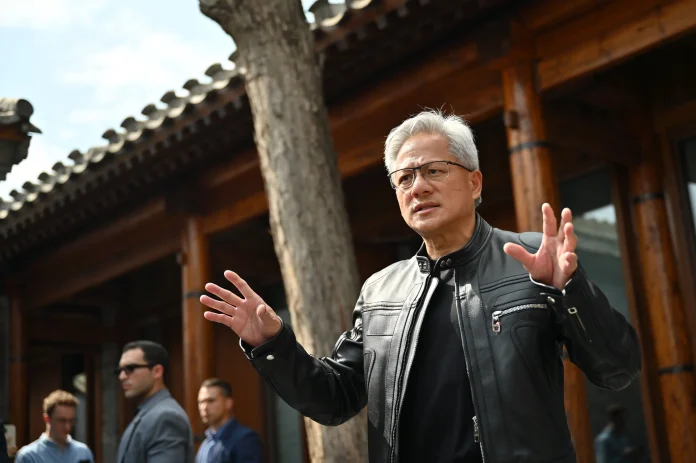
Nvidia CEO Jensen Huang delivered one of the most candid assessments of the US chip export control regime to date on May 3, 2026, telling investors that his company now holds effectively “zero percent” market share in China’s AI chip market, and placing the blame squarely on Washington’s escalating export restrictions.
The admission, made during a public investor event, marks a striking reversal for a company that once generated roughly 25 percent of its total revenue from Chinese customers. It also represents the starkest acknowledgment yet from a major US semiconductor executive that the export control strategy, far from containing China’s AI capabilities, has instead handed the market to domestic Chinese chipmakers.
From Market Leader to Zero: How Nvidia Lost China
Nvidia’s decline in China did not happen overnight. The company first faced export restrictions in September 2022, when the Biden administration barred sales of its A100 and H100 chips to Chinese customers. Nvidia responded by engineering downgraded variants, the A800 and H800, specifically designed to comply with the performance thresholds set by US regulators. Those chips were subsequently banned in October 2023, prompting Nvidia to develop yet another China-specific product, the H20.
The H20, launched in early 2024, was designed to thread the needle between commercial viability and regulatory compliance. It offered substantially lower compute performance than Nvidia’s flagship products but retained the company’s high-bandwidth memory architecture and software ecosystem. For a period, it sold well: Chinese cloud providers, including Alibaba, Tencent, and ByteDance, placed large orders, and Nvidia’s China revenue briefly recovered.
That window closed in April 2025, when the US Commerce Department added the H20 to its restricted list, citing concerns that the chip’s memory bandwidth could support large-scale AI training when deployed in clusters. The ban was immediate and comprehensive. Nvidia was left with no compliant product to sell into China’s AI infrastructure market.
Domestic Alternatives Fill the Gap
The vacuum Nvidia left behind was not empty for long. Chinese chipmakers, led by Cambricon Technologies and Huawei’s HiSilicon division, had been building domestic alternatives for years, often with explicit government support and the knowledge that US restrictions would eventually force Chinese buyers to switch.
Huawei’s Ascend 910B and the newer Ascend 950, which entered mass production in 2026, have become the primary training chips for China’s largest AI labs. Huawei expects AI chip revenue to jump 60 percent to $12 billion in 2026, a trajectory that would have been unimaginable without the forced substitution that US export controls created. Cambricon, which posted its first-ever profit in early 2026, has seen its stock rise to record highs as DeepSeek’s V4 model launch drove fresh demand for domestic inference chips.
The pattern is not limited to training hardware. Chinese cloud providers have built out inference infrastructure almost entirely on domestic silicon, and the software ecosystem, including optimized versions of PyTorch and a growing library of domestically developed frameworks, has matured to the point where switching costs are no longer prohibitive.
Huang’s Verdict: The Policy Has “Largely Backfired”
Huang’s language at the investor event was unusually direct for a CEO navigating a politically sensitive topic. He described the export control policy as having “already largely backfired,” arguing that the restrictions did not prevent China from developing capable AI systems but instead accelerated the development of a domestic chip industry that now competes directly with Nvidia on its home turf.
The argument echoes a growing body of analysis from economists and national security researchers who have questioned whether blanket chip export controls achieve their stated goals. The core problem, as Huang framed it, is that the restrictions created a captive market for Chinese chipmakers. Every dollar that Chinese AI companies could no longer spend on Nvidia hardware became a dollar that flowed to Huawei, Cambricon, Moore Threads, and a constellation of smaller domestic suppliers. The result is a Chinese chip industry that is better capitalized, more technically sophisticated, and more deeply integrated into the AI supply chain than it would have been without the restrictions.
The $50 Billion Question
Nvidia’s lost China revenue is not merely a corporate problem. The company’s current market capitalization, which peaked above $3 trillion in 2025, was built in part on the assumption that AI infrastructure spending would remain concentrated in a small number of hyperscale markets where Nvidia held near-monopoly positions. China was one of those markets.
The loss of China revenue has forced Nvidia to accelerate its push into other geographies, including Southeast Asia, the Middle East, and India, where the regulatory environment is less restrictive. It has also intensified the company’s focus on software and services, where margins are higher, and the risk of export-control-driven displacement is lower.
But the strategic damage extends beyond Nvidia’s balance sheet. The US chip export control regime was premised on the idea that China could not develop competitive alternatives within a meaningful timeframe. That premise has been falsified. Chinese AI chip market revenue is projected to reach RMB 1.34 trillion ($196 billion) by 2029, growing at a compound annual rate of 54 percent, a trajectory that reflects not just demand growth but the successful localization of supply.
What Comes Next
The Biden and Trump administrations’ successive rounds of chip export controls were designed to maintain a technology gap between US and Chinese AI capabilities. Huang’s admission suggests that gap, at least in terms of available hardware, has narrowed significantly. Chinese AI labs are now training frontier models, including DeepSeek V4, on domestically produced chips, a move Nvidia’s CEO acknowledged is competitive with US frontier systems.
The policy debate in Washington is shifting accordingly. A growing faction of analysts and former officials argues that the current approach has produced the worst of both outcomes: it has damaged US semiconductor companies’ revenues while failing to prevent China from building capable AI systems. An alternative school of thought holds that the restrictions have bought time and that the gap in the most advanced process nodes, where TSMC’s 3nm and 2nm capabilities remain out of China’s reach, still matters for the next generation of AI hardware.
What is no longer in dispute, at least according to the CEO of the world’s most valuable semiconductor company, is that the current policy has not achieved its primary objective. Nvidia’s zero percent China market share is the most expensive data point in that argument.
(Related: Chinese Tech Giants Scramble for Huawei Ascend Chips as DeepSeek V4 Triggers Supply Crunch |Huawei Ascend 950 Production Scales to 750,000 Units in 2026)