
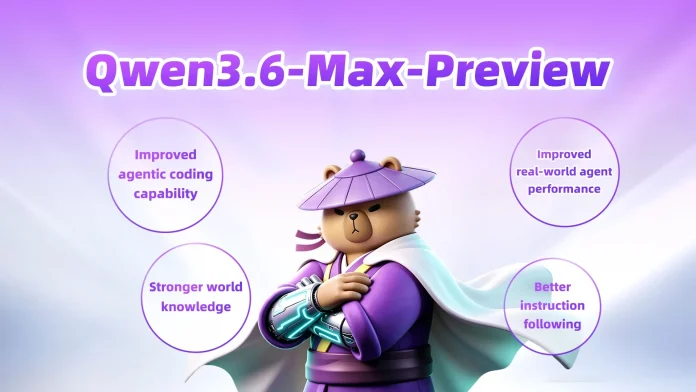
In a significant advancement for the Chinese artificial intelligence ecosystem, Alibaba Cloud has officially released an early preview of its next-generation proprietary model, Qwen3.6-Max-Preview. The release, detailed in a blog post on the Qwen Studio website, represents a major leap forward in agentic coding capabilities, world knowledge, and instruction following. This new model is positioned to compete directly with the most advanced frontier models globally, further solidifying Alibaba’s status as a leading force in AI research and development.
Dominating Coding Benchmarks
The most notable aspect of the Qwen3.6-Max-Preview release is its exceptional performance on complex coding tasks. According to Alibaba’s internal evaluations, the new model achieves the top score on six major coding benchmarks: SWE-bench Pro, Terminal-Bench 2.0, SkillsBench, QwenClawBench, QwenWebBench, and SciCode. These benchmarks are designed to test a model’s ability to not only generate code but also to understand complex software repositories, interact with terminal environments, and execute multi-step programming tasks autonomously.
The improvements over its predecessor, Qwen3.6-Plus, are substantial. The preview release demonstrates significant gains in agentic coding, with scores increasing by +9.9 on SkillsBench, +6.3 on SciCode, +5.0 on NL2Repo, and +3.8 on Terminal-Bench 2.0. These enhancements are critical for developing sophisticated AI agents that can assist developers in writing, debugging, and maintaining complex software systems. By excelling in these areas, Qwen3.6-Max-Preview is establishing itself as a premier tool for software engineering and automated development workflows.
To further support agentic tasks, the new release introduces a preserve_thinking feature. This capability allows the model to retain its reasoning content from all preceding turns in a conversation, providing a more coherent and context-aware interaction. This is particularly valuable for complex, multi-step tasks where the AI agent needs to maintain a clear understanding of the overall objective and the steps already taken to achieve it. The inclusion of this feature underscores Alibaba’s focus on building models that are not just conversational but truly capable of autonomous action.
Enhanced World Knowledge and Instruction Following
Beyond its coding prowess, Qwen3.6-Max-Preview also demonstrates significant improvements in general intelligence. The model exhibits stronger world knowledge, as evidenced by its increased scores on the SuperGPQA (+2.3) and QwenChineseBench (+5.3) evaluations. These benchmarks test a model’s ability to answer complex questions across a wide range of academic and professional domains, requiring a deep understanding of factual information and logical reasoning.
Furthermore, the preview release shows better instruction following capabilities, with a +2.8 improvement on the ToolcallFormatIFBench. This enhancement is crucial for ensuring that the model can accurately interpret and execute complex user commands, particularly when interacting with external tools and APIs. The ability to reliably follow instructions is a foundational requirement for any AI agent intended for enterprise or commercial use, and Alibaba’s focus on this area highlights its commitment to building practical, deployable AI solutions.
(Related: Alibaba’s Qwen3.6-Plus Breaks Token Records with Enhanced Agentic Capabilities)
Accessibility and Future Development
Qwen3.6-Max-Preview is currently available as a hosted proprietary model via the Alibaba Cloud Model Studio API and can also be accessed interactively through Qwen Studio. The API supports industry-standard protocols, including chat completions and responses that are compatible with OpenAI’s specification, as well as an interface compatible with Anthropic. This broad compatibility ensures developers can easily integrate the new model into their existing workflows and applications, minimizing the friction of adopting new AI technologies.
As an early preview release, Qwen3.6-Max-Preview is still under active development. Alibaba has stated that it is continuing to iterate on the model and expects further improvements in subsequent versions. This iterative approach allows the company to gather valuable feedback from the developer community and refine the model’s capabilities based on real-world usage. The rapid pace of development within the Qwen series highlights the intense competition in the global AI market and Alibaba’s determination to remain at the forefront of this technological revolution.
The release of Qwen3.6-Max-Preview is a clear indication that Chinese technology giants are not merely keeping pace with their Western counterparts but are actively pushing the boundaries of what is possible with artificial intelligence. By delivering a model that excels in complex agentic coding tasks and demonstrates strong general intelligence, Alibaba is providing developers with a powerful new tool for building the next generation of AI applications. As the model continues to evolve, it is likely to play a central role in shaping the future of software development and automated workflows both in China and globally.
The Architecture Behind the Performance
The strong performance of Qwen3.6-Max-Preview stems from its underlying architecture. The model uses a sparse mixture-of-experts (MoE) architecture, a technique that enables massive scale without a proportional increase in computational cost during inference. With approximately 1 trillion total parameters, the MoE architecture ensures that only a subset of these parameters, the “experts”, are activated for any given task. This approach enables the model to maintain high efficiency while still possessing the vast knowledge base and reasoning capabilities required to dominate complex benchmarks.
This architectural choice is particularly relevant in the context of agentic coding, where a model must quickly switch between different types of reasoning, such as understanding natural language instructions, analyzing code syntax, and interacting with external environments. The MoE design allows Qwen3.6-Max-Preview to allocate the most appropriate experts to each specific sub-task, resulting in the significant performance gains observed in the SkillsBench and SciCode evaluations. As Alibaba continues to refine this architecture, the gap between open-source and proprietary frontier models is likely to widen, further cementing the company’s leadership in the AI space.