
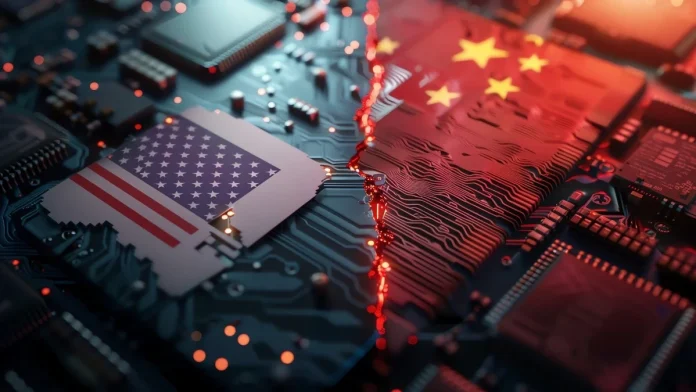
The Unintended Consequences of Export Controls
Four years after the United States implemented sweeping export controls designed to cripple China’s access to advanced semiconductors, the technological landscape is shifting in unexpected ways. The Biden administration’s strategy aimed to maintain a decisive US lead in artificial intelligence by starving Chinese labs of the cutting-edge chips required to train frontier models. However, as reported by DW in a detailed analysis on China’s chip industry, these restrictions have acted as a powerful catalyst, accelerating Beijing’s push for semiconductor self-reliance and fostering a domestic ecosystem that is increasingly competitive, albeit on different terms.
While China still trails the US at the absolute cutting edge of chip design and manufacturing, the performance gap is narrowing significantly. A recent report by the Stanford Institute for Human-Centered Artificial Intelligence (HAI) highlighted this trend, noting that the US lead in AI performance over China has shrunk to a mere 2.7%. This dramatic closing of the gap is not solely the result of matching US hardware capabilities; rather, it stems from China’s strategic pivot toward developing “good-enough” technology that delivers strong performance at a fraction of the cost.
The Rise of “Good-Enough” Technology and Cost Efficiency
DW notes that China’s approach to the AI race is increasingly characterized by a focus on practical, task-oriented applications that do not necessarily require the massive computing power of frontier models. By optimizing algorithms and leveraging domestic chips like Huawei’s Ascend series, Chinese tech companies are achieving impressive results without relying on the most advanced and heavily restricted US hardware. This strategy plays to China’s industrial strengths, prioritizing scale, efficiency, and rapid deployment over absolute peak performance.
The economic implications of this shift are profound. Chinese AI systems and the chips that power them are significantly cheaper than their Western counterparts. This cost advantage is driving rapid adoption across the Global South, where governments and enterprises are increasingly opting for affordable Chinese solutions over expensive US alternatives. Market intelligence firm Trendforce recently noted that Chinese AI platforms, including those developed by Alibaba and DeepSeek, had captured roughly 15% of the global AI model market by late 2025. This growing market share poses a direct, long-term threat to the global dominance of US tech giants.
The Energy Equation: China’s Hidden Advantage
The competition in AI is not solely about silicon; it is increasingly about energy. The massive data centers required to train and run advanced AI models consume extraordinary amounts of electricity. In the United States, the rapid expansion of AI infrastructure is straining the power grid, with some analysts warning that energy constraints could soon limit the growth of the sector. This presents a significant vulnerability for Silicon Valley’s ambitions.
DW says that China possesses a distinct advantage in this critical area. The country’s fast-expanding power sector provides a robust foundation for scaling AI infrastructure. With an estimated 400 gigawatts of spare capacity projected by 2030, China can roll out data centers at a massive scale, even if its domestic chips are less energy-efficient than the latest offerings from NVIDIA or AMD. As Ryu Yongwook, an expert in US-China tech rivalry, observed, “Cheap energy in China goes some way to make up for its relative chip inefficiency.” This energy abundance provides Beijing with a crucial lever in the ongoing technological competition.
The Future of the Global Tech Ecosystem
The deepening US-China chip rivalry is fundamentally reshaping the global technology industry. The US strategy of technological containment has spurred the creation of a parallel, increasingly capable Chinese ecosystem. While the US maintains a lead in foundational research and the absolute highest-end hardware, China’s focus on cost-effective, practical AI applications is proving highly successful in capturing global market share, particularly in developing economies.
The long-term outcome of this competition remains uncertain. The US may maintain its edge by resolving its energy constraints and continuing to push the boundaries of AI research. Alternatively, the world may see the emergence of two distinct, competing AI ecosystems, divided along geopolitical lines. What is clear, however, is that China’s ability to deliver strong AI performance at a lower cost is a formidable challenge that US policymakers and tech leaders can no longer afford to underestimate. The race is no longer just about who has the fastest chip but also about who can deploy AI most effectively and affordably on a global scale.
Sources: