
Strategic Investment Accelerates Household Robotics Deployment
The race to bring humanoid robots out of the laboratory and into the living room has received a massive financial injection. X Square Robot, a Shenzhen-based robotics startup, has successfully closed a $276 million Series B funding round. The investment was led by the strategic investment arm of consumer electronics giant Xiaomi, signaling a strong vote of confidence in the commercial viability of domestic humanoid assistants. This substantial capital influx will be primarily directed toward scaling the production and deployment of the company’s flagship AI model, Wall-B, which is specifically designed to navigate the complex and unpredictable environments of everyday households.
This latest funding round builds upon a rapidly accumulating war chest for X Square Robot. The company has been on a relentless fundraising trajectory, having previously secured hundreds of millions of yuan in a February round that pushed its valuation past the 10 billion yuan mark. Prior to that, a 1 billion yuan Series A++ round in January saw participation from heavyweight investors including ByteDance, HongShan (formerly Sequoia Capital China), and Shenzhen Capital Group. Even earlier, in September 2025, the startup raised nearly 1 billion yuan in a Series A+ round backed by Alibaba Cloud and SAIC Capital. The sustained interest from China’s top-tier technology conglomerates and venture capital firms underscores the high stakes and immense potential perceived in the humanoid robotics sector.
The Wall-B Model and the Challenge of Unstructured Environments
At the core of X Square Robot’s value proposition is its proprietary artificial intelligence model, Wall-B. Unlike robots designed for highly controlled industrial settings or choreographed public demonstrations, Wall-B has been trained on data collected from more than 100 real-world households. This exposure to “noisy” conditions—ranging from scattered toys and unpredictable pets to varying lighting and spatial layouts—is critical for developing the robust perception and decision-making capabilities required for domestic chores.
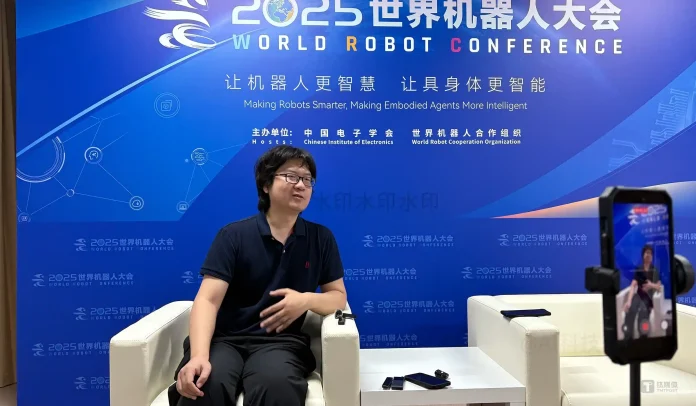
During a recent launch event in Beijing, the company demonstrated the robot’s ability to perform delicate tasks, such as arranging flowers into a vase and sorting out litter. While these actions might seem modest compared to the backflips and sprints showcased by other robotics firms, they represent a significant leap in fine motor control and spatial awareness. Wang Qian, the chief executive officer of X Square Robot, articulated the industry’s core challenge: “The hardware is largely there, but the brain hasn’t caught up.” He emphasized that while navigating a constant gravitational field for a marathon is a solved problem, manipulating objects with human-like dexterity requires millimeter-level precision, where being off by even 0.1 millimeters can result in task failure.
Bridging the Gap Between Hardware Capabilities and Cognitive Software
The integration of advanced AI models like Wall-B is the critical bridge between impressive mechanical engineering and practical utility. Repetitive actions require relatively simple datasets, but navigating a household demands a sophisticated cognitive architecture capable of processing multimodal inputs in real-time. By leveraging the extensive data gathered from its 100-household trial, X Square Robot is refining Wall-B’s ability to perceive gravity, light, and spatial relationships with a level of nuance approaching human capability.
This focus on cognitive software aligns with broader trends in the Chinese technology ecosystem, where companies are increasingly prioritizing the development of embodied intelligence. The goal is to create machines that not only move like humans but also understand and interact with their environment in meaningful ways. The backing from Xiaomi, a company with a vast ecosystem of smart home devices, suggests potential synergies where X Square Robot’s humanoids could seamlessly integrate with existing smart home infrastructure, creating a more cohesive and automated domestic experience.
Commercialization Strategy and the 58.com Partnership
X Square Robot is not merely focused on research and development; the company is aggressively pursuing commercialization. The Wall-B model is slated to be introduced into its home-cleaning robots by late May 2026. In a strategic move to test the market and gather further real-world data, the startup entered into a partnership last month with 58.com, a major Chinese online classifieds and services platform. This collaboration allows users in Shenzhen to book a hybrid cleaning service that combines a professional human cleaner with one of X Square Robot’s home-cleaning machines.
This hybrid approach serves multiple purposes. It provides immediate value to consumers while simultaneously serving as a massive, real-world beta test for the robots. The data collected from these deployments will be invaluable for further refining the Wall-B model, creating a continuous feedback loop of improvement. Furthermore, it familiarizes the public with the presence of humanoid robots in their homes, potentially lowering adoption barriers when fully autonomous models become available.
Implications for the Global Robotics Landscape
The rapid advancement and aggressive capitalization of companies like X Square Robot highlight China’s determination to lead the global humanoid robotics market. EastFrontier has reported how China already ships more robots than any other country. While Western companies have made significant strides in hardware development, the sheer scale of investment and the rapid iteration cycles enabled by China’s robust manufacturing ecosystem and vast data resources present a formidable competitive advantage. As these robots transition from novelties to practical household appliances, the implications for labor markets, consumer electronics, and the broader economy will be profound. The success of X Square Robot’s upcoming household trials will be a critical bellwether for the industry, potentially accelerating the timeline for widespread adoption of humanoid robots.