
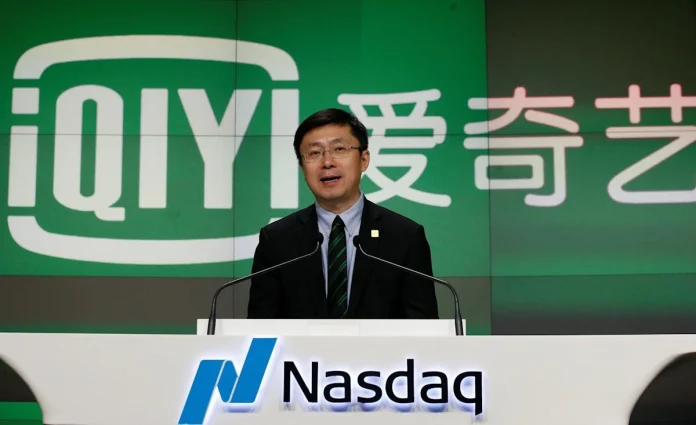
iQiyi CEO Gong Yu stated at an industry conference that artificial intelligence will be responsible for generating “most” of the platform’s films and television shows within five years, according to Gizmodo’s April 21 report. iQiyi, which is owned by Baidu and is one of China’s three dominant streaming platforms alongside Youku (Alibaba) and Tencent Video, has been integrating AI into its content production pipeline for several years. But Gong Yu’s statement — the most explicit public commitment to AI-generated content from a major Chinese streaming executive — has triggered a significant backlash from the Chinese entertainment industry.
What Gong Yu Actually Said
Gong Yu’s remarks were made in the context of a discussion about production costs and content economics. He framed the transition as an economic inevitability, citing AI’s potential to reduce production costs by an order of magnitude, a tenfold reduction, as the primary driver, a figure he has referenced in prior public statements about the industry’s direction. iQiyi has already been using AI for short-form content, visual effects, and post-production work, and Gong Yu’s statement extends that trajectory to long-form scripted content, the films and dramas that are the platform’s flagship products.
The “order of magnitude” cost reduction framing is significant. Chinese drama production has become increasingly expensive as competition for top talent has driven up actor fees and production budgets. A major Chinese drama can cost hundreds of millions of yuan to produce, with a significant portion of that budget going to cast and crew compensation. If AI can genuinely reduce those costs by a factor of ten, the economic logic for adoption is compelling regardless of the creative implications.
The Entertainment Industry’s Response
The reaction from China’s entertainment industry has been swift and pointed. Actors, directors, and screenwriters have used social media to express concern about the implications of AI-generated content for their livelihoods. The Chinese entertainment industry employs hundreds of thousands of people across production, distribution, and related services, and the prospect of AI replacing human creative labor has generated anxiety similar to debates in Hollywood following the 2023 writers’ and actors’ strikes.
The backlash is not purely economic. Chinese actors and directors have also raised questions about the creative quality of AI-generated content and whether audiences will accept it. China’s streaming market is intensely competitive, and content quality is the primary differentiator between platforms. If AI-generated content is perceived as lower quality than human-produced content, the cost savings may come at the expense of audience engagement and subscription retention.
iQiyi’s AI Content Track Record
iQiyi has been one of the more aggressive adopters of AI in content production among Chinese streaming platforms. The company has used AI for dubbing, subtitle generation, visual effects enhancement, and the creation of short-form content for its social features. It has also experimented with AI-generated virtual influencers and AI-assisted scriptwriting tools.
The platform’s parent company, Baidu, has been developing AI content generation capabilities as part of its broader AI strategy. Baidu’s Ernie Bot and its suite of AI creative tools have been integrated into iQiyi’s production workflows, giving the platform access to AI capabilities that are tightly integrated with its existing technology infrastructure. This integration gives iQiyi a potential advantage over competitors that are sourcing AI tools from third parties.
The Broader Debate About AI and Chinese Entertainment
The iQiyi controversy is part of a broader debate in China about the role of AI in creative industries. The Chinese government has been supportive of AI adoption in entertainment as part of its broader AI development agenda, while also being attentive to the social implications of rapid automation. The Ministry of Culture and Tourism has been developing guidelines for AI-generated content, and the Cyberspace Administration of China has already implemented rules requiring disclosure of AI-generated content to consumers.
The tension between economic efficiency and employment protection is particularly acute in China’s entertainment industry, which has been a significant source of employment and cultural soft power. The government’s approach to this tension, whether it prioritizes AI adoption or worker protection, will shape how quickly platforms like iQiyi can implement the vision that Gong Yu articulated.
For international observers, the iQiyi announcement is a preview of debates that will play out in entertainment industries globally as AI generation capabilities improve. China’s scale, iQiyi alone has hundreds of millions of registered users, means that the decisions made by Chinese streaming platforms about AI adoption will have significant implications for the global entertainment industry, both as a model and as a competitive force.
What Five Years Actually Means
Gong Yu’s five-year timeline deserves scrutiny. AI video generation has improved dramatically in 2024 and 2025, but generating a full-length drama series with consistent characters, a coherent narrative, and production quality that meets audience expectations remains a significant technical challenge. The gap between AI-generated short-form content and AI-generated long-form scripted drama is substantial.
The more likely near-term trajectory is a hybrid model in which AI handles specific production tasks such as background generation, visual effects, minor character roles, and post-production, while human creative talent remains central to the core narrative and performance elements. This hybrid approach is already being implemented by major Hollywood studios and is likely to be the dominant model in Chinese streaming production for the next several years, regardless of what Gong Yu’s five-year vision implies.