
A Nationwide Mandate for AI Literacy
In a sweeping initiative to secure long-term technological supremacy, China has unveiled a comprehensive plan to embed artificial intelligence education across its entire education system. As EastFrontier has reported earlier, the Ministry of Education’s new “AI + Education” plan mandates the integration of AI literacy from kindergarten through university, fundamentally altering the curriculum for the country’s approximately 280 million students, the world’s largest national school system, spanning 440,000 institutions.
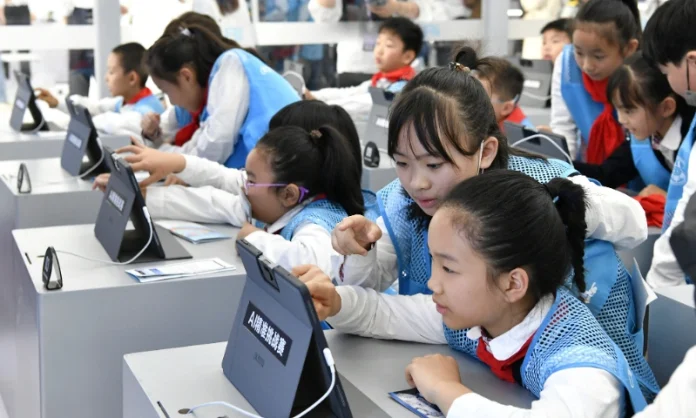
The ambitious policy sets a clear target: by 2030, AI courses will be mandatory in all K-12 schools nationwide. This is not merely an extracurricular addition but a core structural reform aimed at building a comprehensive AI literacy system that spans all levels of formal and lifelong learning. Starting as early as September 2025, AI will be introduced as a mandatory school subject for children as young as six years old.
The scale of this deployment is unprecedented globally. While other nations are debating the role of generative AI tools in classrooms, China is moving aggressively to institutionalize AI comprehension as a foundational academic skill, on par with mathematics and native language proficiency.
What the Curriculum Actually Looks Like
The curriculum is designed to scale in complexity as students progress through the educational system, shifting from conceptual familiarity to practical application and ethical understanding.
For primary school students, the focus is on playful, hands-on experiences. Children will be introduced to basic AI concepts through interactive games and simple robotics, fostering an early intuition for how algorithms process information and make decisions. The goal at this stage is demystification—ensuring the next generation views AI as a standard tool rather than an opaque technology.
As students enter middle and high school, the curriculum pivots toward technical proficiency. Coursework will include foundational programming, data processing, and the mechanics of machine learning models. Students will be expected to not only use AI tools but to understand the underlying logic of how they are built and trained.
At the university level, the integration becomes highly specialized. The plan encourages higher education institutions to develop AI-focused degree programs and to embed AI applications into non-technical disciplines, ensuring that graduates in fields ranging from medicine to the humanities are equipped to leverage AI in their respective professions.
Equipping the Educators
A critical component of the Ministry of Education’s plan is the rapid upskilling of the teaching workforce. Recognizing that a curriculum is only as effective as those delivering it, the policy makes it compulsory for teachers to obtain AI certifications. Educators are required to undergo training not only to teach new AI subjects but also to use AI-driven pedagogical tools to enhance their teaching efficiency and personalize student learning experiences.
This top-down mandate reflects Beijing’s recognition that the future economic landscape will be entirely AI-mediated. By systematically training approximately 280 million students in AI literacy, China is engineering a massive, highly capable talent pipeline. This initiative ensures that the country’s future workforce will not just be consumers of artificial intelligence, but native operators and developers, providing a profound structural advantage in the global digital economy.