
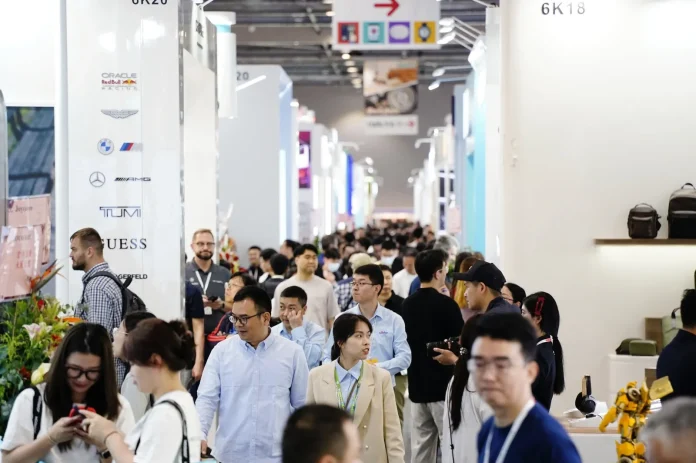
For years, China’s humanoid robotics and AI hardware industry has been a story told largely within China’s borders, for domestic investors, domestic policy audiences, and domestic manufacturers. The opening of Phase II of the Global Sources Hong Kong Shows on April 18 marks a meaningful shift. For the first time in the show’s history, a dedicated “Humanoid Robot Zone”, branded the Physical.ai Lab, has been added to the floor at AsiaWorld-Expo, running through April 21. The message is straightforward: China’s AI hardware has reached a level of commercial maturity, ready for sourcing by global buyers.
From Domestic Milestone to Global Sourcing Event
The Global Sources Hong Kong Shows is one of Asia’s largest B2B sourcing events, bringing together over 2,000 suppliers across nearly 4,000 booths this edition. Phase II showcases approximately 150,000 new products spanning mobile devices, smart wearables, AR/VR, smart home solutions, personal healthcare, and pet products. Global pre-registered buyers grew 35% year on year as of March, with particularly strong increases from Eastern Europe, Western Europe, the United States, and ASEAN, a sign that international procurement teams are actively looking to China’s AI hardware ecosystem for their next product cycles.
The most significant structural change this year is not the volume of products on display, but where AI appears. In previous years, AI was largely confined to a standalone technology zone — a cordoned-off area for early-stage demonstrations. This year, according to John Kao, Vice President of Hong Kong Shows and Overseas Shows at Global Sources, “AI is no longer confined to a standalone tech zone; it has permeated virtually every product category, from smart wearables and home security to personal healthcare. AI has become the core driving force behind product upgrades.”
The Physical.ai Lab: Robots Ready for Commercial Orders
The centerpiece of the AI transformation at this year’s show is the Physical.ai Lab, introduced for the first time. In line with China’s designation of humanoid robots as a strategic emerging industry, the lab showcases robot products that have already entered the commercialization stage — a deliberate distinction from the prototype demonstrations that have characterized robotics showcases in previous years. Products on display include humanoid robots, embodied intelligent robots, robotic lawn mowers, and educational robots.
The show floor demonstrations underscored the point. Unitree Robotics — the Hangzhou-based company known for its quadruped and humanoid robots — staged live kung fu and dance performances on the show floor, demonstrating advanced capabilities in motion planning and real-time control. Linkerbot’s robot band also performed, illustrating the commercial potential of robotics in entertainment and service contexts. These were not proof-of-concept demonstrations; they were sales pitches directed at international buyers with purchasing authority.
The broader AI Pavilion, which sits alongside the Physical.ai Lab, brings together over 1,200 booths across seven segments: AI terminal devices, AI wearables, AI glasses, AI toys, AI pet products, AI personal healthcare, and AI convergence products. The number of mobile accessories exhibitors grew by 50% compared with the same period in 2025, reflecting the rapid integration of AI features into mass-market consumer electronics.
A New Award Category Signals a New Industry Standard
The introduction of a new “AI Innovation Award” category at this year’s Global Sources Innovation Awards is a small but telling signal. Award categories at trade shows tend to reflect where the industry’s center of gravity has moved. The fact that Global Sources has created a dedicated AI award — alongside its existing partnerships with the European Product Design Award — suggests that AI integration is now considered a baseline expectation for competitive products, not a differentiating feature.
The concurrent AI & Robotics Summit (AIRS), running alongside the show, reinforces this framing. Sessions include “The AI Gold Rush” on April 19 and “Consumer Tech Futures” on April 20, bringing together industry experts to discuss how AI is restructuring the consumer electronics value chain. The summit’s framing, AI as a gold rush, not a future possibility, reflects the commercial urgency that now characterizes the sector.
What This Means for China’s AI Hardware Export Ambitions
The Global Sources show is a useful barometer for where China’s AI hardware industry stands in its export cycle. The presence of a dedicated humanoid robot zone, live robot demonstrations, and a new AI award category at one of Asia’s premier sourcing events signals that Chinese manufacturers believe their AI and robotics products are ready for international commercial deployment, not just domestic pilots. This also ties in with how China’s AI-related exports now make up 19% of global supply.
The 35% year-on-year growth in pre-registered international buyers, combined with strong representation from Western Europe and the United States, suggests that this confidence is not entirely misplaced. For global buyers, the show represents a practical opportunity to evaluate Chinese AI hardware at a stage when supply chains are mature enough to support volume orders. For China’s robotics and AI hardware sector, it marks the beginning of a new phase, in which the question is no longer whether the technology works, but whether international markets are ready to buy it at scale.