
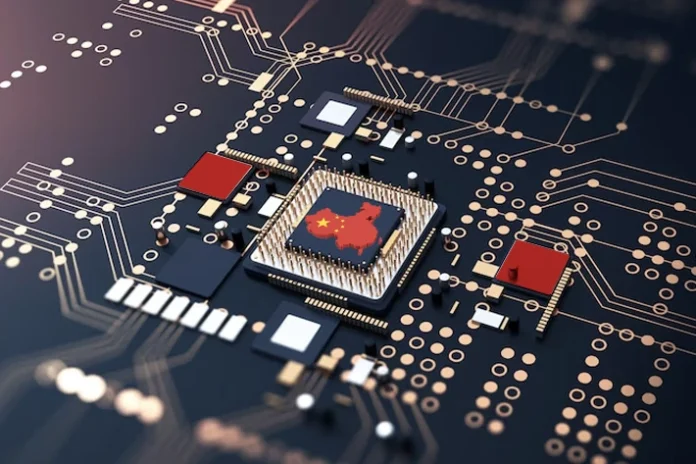
China’s relentless drive for semiconductor self-sufficiency is yielding tangible results, particularly in the critical domain of artificial intelligence chips. According to recent industry data, Chinese companies have successfully captured a 41% share of their domestic AI chip market. This milestone marks a significant shift in the global semiconductor landscape, demonstrating that U.S. export controls, rather than crippling the Chinese industry, have accelerated its domestic development.
The momentum is expected to continue. A recent forecast by Morgan Stanley projects that China’s AI chip self-sufficiency rate could reach 76% by 2030. This projection suggests that within the next four years, China will have largely insulated its core AI infrastructure from external supply shocks and geopolitical leverage.
The Catalyst of Export Controls
The rapid growth of China’s domestic AI chip sector is a direct consequence of the escalating U.S.-China tech war. As Washington has systematically tightened restrictions on the export of advanced AI accelerators from companies like Nvidia and AMD, Chinese tech giants and cloud providers have been forced to pivot to domestic alternatives.
Companies like Huawei, with its Ascend series of AI processors, have emerged as the primary beneficiaries of this forced decoupling. The Ascend 910B, and the upcoming 910C, are increasingly being adopted by Chinese enterprises to train and run large language models. This domestic adoption provides the crucial revenue and real-world feedback loop necessary for Chinese chip designers to rapidly iterate and improve their architectures.
This push for self-reliance is heavily subsidized by the state. Recent reports indicate that China is subsidizing chipmaking at 3.6 times the rate of the United States, pouring massive capital into foundries like SMIC to expand production capacity, even as they rely on older, less efficient manufacturing equipment.
Implications for the Global Market
The rise of China’s domestic AI chip industry has profound implications for the global semiconductor market, particularly for nations caught in the crossfire. The Seoul Economic Daily recently highlighted the growing concern in South Korea, noting that the Harvard Kennedy School’s Belfer Center has ranked Korea’s semiconductor competitiveness fifth globally—trailing the United States, China, Japan, and Taiwan.
The analysis suggests that Korea’s heavy reliance on memory semiconductors leaves it vulnerable as the industry’s center of gravity shifts toward system semiconductors and AI processors. Experts are increasingly urging the Korean semiconductor industry to aggressively expand its footprint in the logic and AI chip sectors to maintain its global standing.
While Chinese AI chips may still lag behind the absolute cutting edge of Nvidia’s latest offerings in terms of raw performance and software ecosystem maturity, they are clearly crossing the threshold of “good enough” for a vast array of commercial applications. As the self-sufficiency rate climbs toward the projected 76%, the global semiconductor market will increasingly bifurcate, with China operating a largely self-contained, parallel ecosystem for artificial intelligence hardware.