
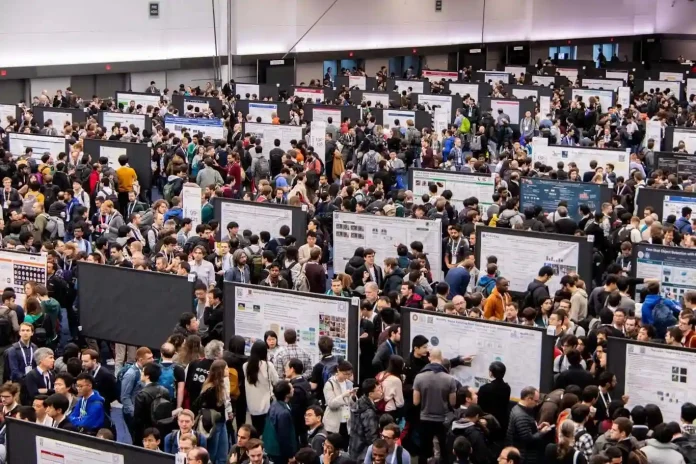
The global artificial intelligence research community is facing an unprecedented fracture. The China Association for Science and Technology (CAST), a key state-backed organization that funds academic exchanges, has announced a boycott of the prestigious Neural Information Processing Systems (NeurIPS) conference. This decision follows a controversial policy change by the US-based organizers that initially appeared to exclude researchers associated with US-sanctioned Chinese institutions.
While NeurIPS later apologized and narrowed the scope of its restrictions, CAST is standing firm. The organization stated it will no longer fund researcher attendance at the conference and will de-emphasize papers presented at NeurIPS in crucial researcher evaluations. This move threatens to gut one of the world’s most important AI gatherings, given that China-based researchers accounted for more than half of the lead authors at the most recent NeurIPS conference, according to a recent Nature report.
The Catalyst: US Sanctions and Conference Policies
The controversy ignited on March 23, 2026, when NeurIPS organizers announced that papers submitted by researchers associated with “US-sanctioned” institutions would be rejected. The announcement included a link to a US government web page listing prominent Chinese technology firms, including Huawei, a previous sponsor of the conference.
This policy immediately sparked an outcry across social media, with researchers from various nationalities threatening to withdraw their participation. The China Computer Federation (CCF), a leading professional body for computer scientists, joined CAST in calling for a boycott. Although NeurIPS subsequently issued an apology and clarified that the ban applied only to a much narrower list of entities, the damage was already done.
CAST released a statement on March 31 confirming that its boycott measures would remain in place. The funding originally allocated for NeurIPS attendance will be redirected to other eligible international or domestic projects and conferences. Yunji Chen, director of the State Key Laboratory of Processors in Beijing, articulated the sentiment driving the boycott, stating that CAST’s action “sends a clear signal: science should not be made a casualty of politics.”
Implications for Global AI Advancement
The potential absence of Chinese researchers at NeurIPS is difficult to overstate. A 2025 study by Digital Science revealed that China publishes the greatest volume of AI papers globally and possesses a talent pool that “dwarfs its rivals.” William Hannas, a China specialist at Georgetown University’s Center for Security and Emerging Technology, noted that without Chinese participation, “NeurIPS would be devastated.”
This boycott is not merely a dispute over conference attendance; it is a manifestation of the deepening technological decoupling between the United States and China. As Washington continues to tighten export controls on advanced semiconductors and restrict collaboration in critical technologies, Beijing is increasingly signaling its willingness and capability to operate independently, a trend we previously explored in our coverage of the wave of elite AI researchers leaving Silicon Valley for China.
Rebecca Arcesati, an AI policy researcher at the Mercator Institute for China Studies, observed that CAST’s decision indicates “China can increasingly stand on its own feet when it comes to advanced AI research.” She added, “This is their way of showing that if Chinese talent isn’t appreciated and welcome to these gatherings, then China will do things more on its own.”
The Shift Toward Domestic AI Ecosystems
The NeurIPS boycott may accelerate a trend that is already underway: the bifurcation of the global AI ecosystem. As Chinese researchers face increasing hurdles in participating in Western-led forums, they are likely to pivot toward domestic conferences and publications. This shift could lead to the emergence of parallel AI research communities, each with its own standards, benchmarks, and foundational models.
This development poses significant challenges for the future of AI safety and governance. Global cooperation is widely considered essential for addressing the existential risks associated with advanced artificial intelligence. If the leading researchers from the world’s two AI superpowers are no longer collaborating or even communicating at major conferences, the prospects for establishing unified global guardrails become increasingly remote.
Furthermore, the boycott highlights the vulnerability of international scientific organizations to geopolitical pressures. As the US-China tech war intensifies, conferences like NeurIPS find themselves caught in the crossfire, forced to navigate complex sanctions regimes while attempting to maintain their commitment to open scientific exchange.
Navigating the New Reality of AI Research
For the international AI community, the NeurIPS controversy serves as a stark warning. The era of unhindered global collaboration in artificial intelligence may be drawing to a close. Researchers, institutions, and policymakers must now adapt to a landscape where geopolitical considerations increasingly dictate the boundaries of scientific inquiry.
The long-term consequences of this fracture remain to be seen. While China’s massive investments in AI research and development ensure it will remain a dominant force, the loss of cross-pollination with Western researchers could slow the overall pace of global innovation. Conversely, the necessity of self-reliance may drive Chinese institutions to accelerate their development of indigenous technologies and platforms.
As the December 2026 NeurIPS conference approaches, the AI world will be watching closely to see the true extent of the boycott. Regardless of the final attendance numbers, the underlying message is clear: the US-China tech war has fundamentally altered the rules of engagement for global scientific collaboration.