
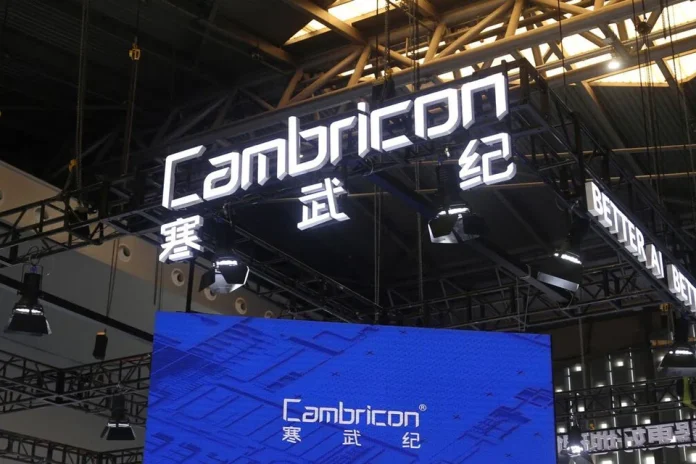
Cambricon Technologies, a leading Chinese developer of artificial intelligence chips, has reported its first-ever annual profit, marking a significant milestone for the company and the broader Chinese semiconductor industry. The achievement, detailed in the company’s 2025 annual report released this week, underscores the accelerating momentum of China’s domestic AI hardware ecosystem in the face of tightening US export controls.
According to the financial filing, Cambricon achieved a net profit of 120 million yuan ($16.5 million) for the fiscal year 2025, a dramatic turnaround from the significant losses reported in previous years. This profitability was driven by a massive surge in revenue, which more than tripled year-over-year to reach 2.8 billion yuan ($385 million). The company attributed this explosive growth to the rapidly expanding domestic demand for AI computing power, fueled by the widespread adoption of large language models and the Chinese government’s aggressive push for technological self-reliance.
Cambricon’s success is particularly notable given the intense pressure facing the Chinese semiconductor industry. The company was added to the US Commerce Department’s Entity List in 2022, severely restricting its access to advanced American technology and manufacturing equipment. However, rather than crippling the firm, these sanctions appear to have catalyzed its growth by forcing Chinese tech giants and government agencies to pivot toward domestic suppliers.
The company’s flagship product, the Siyuan 590 AI accelerator, has emerged as a viable alternative to Nvidia’s highly sought-after GPUs for many domestic clients. While independent benchmarks suggest the Siyuan 590 still lags behind Nvidia’s cutting-edge H100 in peak performance, it offers sufficient capability for a wide range of AI training and inference tasks, particularly when deployed in large clusters. More importantly, it is available without the geopolitical risks and supply chain uncertainties associated with relying on American hardware.
Cambricon’s profitability is not an isolated incident but part of a broader trend across the Chinese technology sector. A recent analysis by People’s Daily highlighted a surge in earnings among Chinese tech firms, particularly those involved in the AI supply chain. Companies specializing in everything from advanced packaging and memory chips to server infrastructure and data center cooling systems are reporting record revenues, driven by the massive investments pouring into China’s AI ecosystem.
This financial success provides crucial validation for Beijing’s strategy of fostering a self-sufficient domestic technology industry. The Chinese government has poured billions of dollars into subsidies, tax breaks, and state-backed investment funds to support companies like Cambricon, recognizing that control over foundational AI hardware is essential for national security and future economic growth. The fact that these companies are now achieving profitability suggests that this state-directed approach is beginning to yield sustainable commercial results.
However, significant challenges remain. While Cambricon has successfully captured a significant share of the domestic market, its ability to compete globally remains severely constrained by US sanctions. The company’s reliance on domestic foundries, such as SMIC, for manufacturing its chips means it is still vulnerable to bottlenecks in advanced lithography equipment. Furthermore, the rapid pace of innovation in the global AI hardware market means Cambricon must continue to invest heavily in research and development simply to maintain its current position relative to industry leaders like Nvidia and AMD.
Despite these hurdles, Cambricon’s first profit represents a psychological turning point for the Chinese AI industry. It demonstrates that domestic firms can not only survive but thrive under the pressure of US export controls, building viable businesses by serving the massive internal market. This success will likely attract further investment and talent into the sector, accelerating the development of China’s independent AI ecosystem.
The implications for the global semiconductor market are profound. As Chinese firms like Cambricon become increasingly competitive, they will gradually erode the market share of Western incumbents within China, the world’s largest consumer of semiconductors. This dynamic will force Western companies to adapt their strategies, potentially leading to increased competition in other global markets and a further bifurcation of the global technology landscape.
Furthermore, Cambricon’s success highlights the growing importance of software ecosystems in the AI hardware race. The company has invested heavily in developing its proprietary software stack, Neuware, to make it easier for developers to port their applications from Nvidia’s dominant CUDA platform. The continued refinement of this software ecosystem will be critical to Cambricon’s long-term success, as hardware performance alone is insufficient to win over developers accustomed to the seamless experience provided by established Western platforms.
Ultimately, Cambricon’s milestone profit serves as a stark reminder that US export controls, while disruptive in the short term, are accelerating the development of a parallel, self-sufficient technology ecosystem in China. As this ecosystem matures, it will increasingly challenge Western dominance in the critical technologies that will define the 21st-century economy. For investors and policymakers alike, Cambricon’s first profit is not merely a financial milestone—it is a strategic signal that the era of unchallenged Western dominance in AI hardware is drawing to a close, and that the global semiconductor industry is entering a new, more competitive, and more fragmented era.