
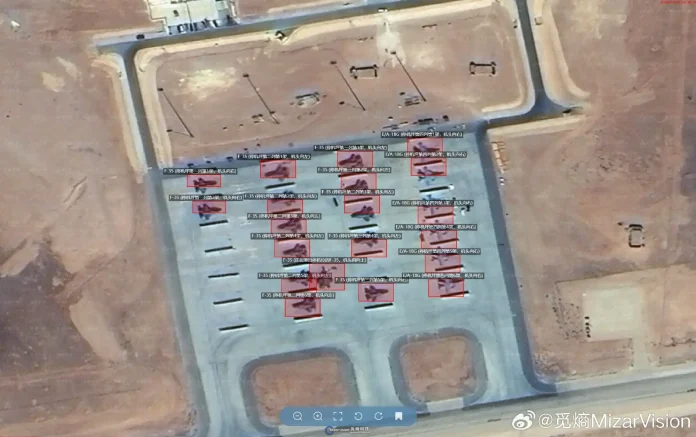
A network of Chinese artificial intelligence startups is reportedly selling advanced, AI-processed intelligence regarding the movements of United States military forces in the Middle East to Iranian state actors, according to recent investigations by Western intelligence analysts and independent researchers. This development represents a significant escalation in the ongoing technological and geopolitical competition between Washington and Beijing, highlighting the increasingly blurred lines between commercial AI development and state-sponsored military intelligence gathering.
The reports center on several Chinese firms, most notably MizarVision, a Beijing-based startup specializing in the application of artificial intelligence to satellite imagery analysis. According to a detailed investigation by Kharon, a data analytics firm specializing in global security threats, MizarVision has developed sophisticated machine learning algorithms capable of rapidly identifying and tracking military assets—including stealth aircraft, naval vessels, and troop deployments—from commercially available satellite data.
The core of the issue lies in the democratization of advanced intelligence capabilities. Historically, the ability to process massive volumes of satellite imagery in near real-time to track adversary movements was the exclusive domain of top-tier national intelligence agencies, primarily those of the United States and its closest allies. However, the rapid advancement of commercial AI models, particularly in the field of computer vision, has dramatically lowered the barrier to entry. Chinese startups like MizarVision are now offering capabilities that rival those of state actors, packaging them as commercial products available to international clients.
According to the Kharon report, MizarVision’s AI models have been specifically trained to identify US military hardware, including the F-22 Raptor and B-2 Spirit stealth bombers, even when deployed in complex or obscured environments. The firm reportedly utilizes a combination of synthetic aperture radar (SAR) data and high-resolution optical imagery, processed through proprietary neural networks, to generate actionable intelligence on US force posture in the Middle East.
The most alarming aspect of these reports is the allegation that this AI-processed intelligence is being sold to Iranian state entities, including the Islamic Revolutionary Guard Corps (IRGC). The Washington Post, citing unnamed US intelligence officials, reported that Iranian forces have utilized data provided by Chinese commercial entities to improve their situational awareness of US deployments in the region, potentially enhancing their ability to target US assets or evade detection.
While the Chinese government has officially denied any involvement in these transactions, maintaining that the firms in question are independent commercial actors, Western analysts remain deeply skeptical. The close integration of China’s commercial tech sector with its military-industrial complex—a strategy officially known as “military-civil fusion”—makes it highly unlikely that such sensitive intelligence sharing could occur without the tacit approval, or at least the willful ignorance, of Beijing.
This development underscores the profound challenges facing US policymakers as they attempt to navigate the intersection of artificial intelligence and national security. Traditional export controls, which focus on restricting the transfer of physical hardware like advanced semiconductors, are ill-equipped to address the proliferation of intangible AI models and the intelligence products they generate. The US government has increasingly relied on targeted sanctions, adding firms like MizarVision to the Commerce Department’s Entity List, but the effectiveness of these measures remains questionable in a highly decentralized and rapidly evolving commercial landscape.
The situation also highlights the growing strategic value of commercial satellite data. As the number of private Earth observation satellites continues to proliferate, the volume of available imagery is expanding exponentially. The true bottleneck is no longer data collection, but data processing. Chinese AI firms, leveraging massive domestic talent pools and significant state support, are rapidly closing the gap with their Western counterparts in this critical area, transforming raw data into strategic assets.
The implications for global security are profound. If advanced AI intelligence capabilities become widely available on the commercial market, it could significantly alter the balance of power in regional conflicts, empowering state and non-state actors who previously lacked access to such sophisticated tools. The reported sale of intelligence to Iran is likely just the beginning of a broader trend, as Chinese AI firms seek to monetize their capabilities in the global arms bazaar.
Furthermore, this development complicates the already fraught relationship between the US and China. The perception that Chinese commercial entities are actively undermining US military operations in the Middle East will undoubtedly fuel calls for more aggressive decoupling and stricter controls on technology transfer. It also raises difficult questions about the future of international cooperation on AI governance, as the dual-use nature of the technology makes it increasingly difficult to distinguish between legitimate commercial activity and state-sponsored espionage.
As the AI arms race accelerates, the focus is shifting from the development of foundational models to their practical application in real-world scenarios. The MizarVision case demonstrates that Chinese firms are not merely replicating Western technology, but actively deploying it in ways that directly challenge US strategic interests. This dynamic will require a fundamental reassessment of US national security strategy in the age of artificial intelligence.