
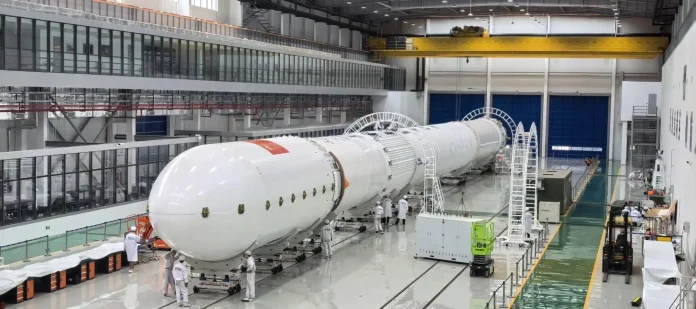
China’s commercial space sector faced a significant setback as Space Pioneer, a leading private aerospace company, announced the failure of its reusable rocket’s maiden flight. The incident highlights the immense technical challenges inherent in developing reusable launch vehicles, a critical capability for deploying the massive satellite constellations necessary for global broadband and advanced AI applications.
While the failure is a blow to Space Pioneer, it also underscores the rapid maturation and high-risk tolerance of China’s commercial space industry. The push for reusable rockets is driven by the need to drastically reduce launch costs, mirroring the success of US-based SpaceX. For China, achieving this capability is essential not only for commercial competitiveness but also for national strategic goals, including the deployment of its own mega-constellations to rival Starlink.
The intersection of aerospace and artificial intelligence is becoming increasingly pronounced, with AI playing a crucial role in rocket design, trajectory optimization, and autonomous flight control systems. The setback for Space Pioneer will likely spur further investment and innovation in these AI-driven aerospace technologies, as Chinese companies race to overcome the technical hurdles of reusability and secure their position in the burgeoning global space economy.
The failure of Space Pioneer’s reusable rocket is a stark reminder of the unforgiving nature of space exploration. Developing a launch vehicle capable of surviving the extreme stresses of ascent, reentry, and landing requires mastering complex aerodynamics, materials science, and propulsion engineering. The fact that a private Chinese company is attempting this feat demonstrates the growing ambition and technical sophistication of the country’s commercial space sector.
This ambition is heavily supported by Beijing, which views a robust commercial space industry as a critical component of its broader technological and strategic goals. The development of reusable rockets is seen as essential for establishing a sustainable and cost-effective presence in space, enabling the deployment of large-scale satellite networks for communications, Earth observation, and navigation. These networks, in turn, are vital for supporting advanced AI applications, such as autonomous driving and global logistics management.
The integration of AI into aerospace engineering is accelerating this process. Machine learning algorithms are increasingly being used to optimize rocket designs, simulate complex flight dynamics, and develop autonomous control systems capable of making split-second decisions during launch and landing. By leveraging AI, Chinese aerospace companies hope to accelerate their development cycles and overcome the technical challenges that have historically hindered progress in reusable rocketry.
However, the Space Pioneer failure also highlights the risks associated with this rapid pace of innovation. The pressure to achieve reusability quickly can lead to aggressive testing schedules and a higher tolerance for failure. While this approach can accelerate learning, it also carries significant financial and reputational risks for the companies involved.
Despite the setback, the long-term trajectory of China’s commercial space sector remains clear. The strategic imperative to develop reusable launch capabilities and deploy mega-constellations will continue to drive massive investment and innovation. As AI becomes increasingly integrated into aerospace engineering, the pace of progress is likely to accelerate, further intensifying the global competition for dominance in space.
Ultimately, the Space Pioneer rocket failure is a temporary hurdle in China’s broader push for commercial space leadership. The incident will undoubtedly provide valuable data and insights that will inform future development efforts, contributing to the maturation of the country’s aerospace industry and its ability to support the next generation of AI-driven applications.