
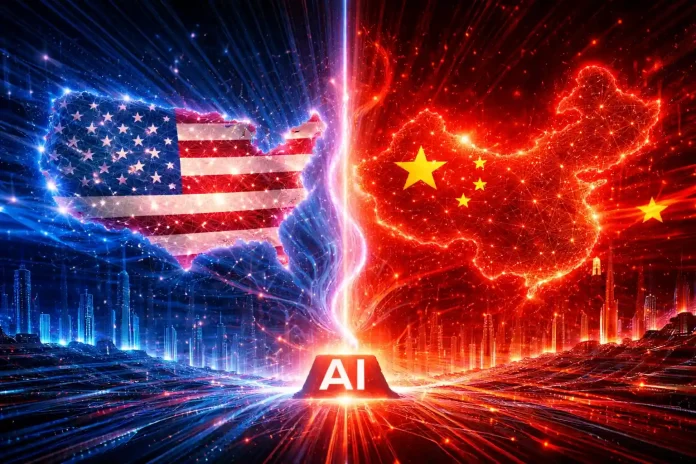
Despite the rhetoric of an AI “arms race” between the United States and China, a complex web of “co-opetition” is emerging, driven by the proliferation of open-source technology. The South China Morning Post notes how a recent example highlights this dynamic: Yang Zhilin, founder of Beijing-based Moonshot AI, delivered nearly identical presentations at Nvidia’s flagship GPU Technology Conference in California and China’s state-backed Zhongguancun Forum in Beijing. Moonshot’s Kimi K2.5 model, trained on Nvidia’s export-compliant H800 GPUs, has become a foundational tool for developers globally.
The reliance is mutual. Cursor, a leading Silicon Valley AI coding startup with a projected $2 billion annual revenue, recently admitted its latest product was built on Kimi 2.5. Other major US tech firms, including Airbnb and Meta, are reportedly utilizing Chinese open-source models to scale their AI ambitions. Cloudflare, which handles a fifth of global internet traffic, stated that integrating Kimi K2.5 into its internal security reviews reduced costs by 77 percent.
Kevin Xu, founder of Interconnected Capital, notes that this convergence has always existed, but the geopolitical climate makes acknowledging it unfavorable for US companies. While the US “big three”—OpenAI, Anthropic, and Google—bar mainland Chinese users from their services, they also benefit from Chinese research. DeepSeek’s GRPO algorithm, for instance, garnered praise from both OpenAI CEO Sam Altman and Anthropic CEO Dario Amodei. Nvidia is actively fostering this convergence, releasing open-source software like NemoClaw to support OpenClaw, an AI agent tool swiftly embraced by Chinese tech giants.
This intricate dance of competition and cooperation underscores the fundamental reality of modern artificial intelligence development: it is an inherently global enterprise. The open-source movement, which has been the engine of AI progress for the past decade, actively resists the kind of national siloing that policymakers in Washington and Beijing are attempting to impose. When a breakthrough occurs, whether in a lab in Silicon Valley or Shenzhen, the underlying principles and often the code itself rapidly diffuse across borders.
For Chinese AI companies, this global integration is both a strategic necessity and a point of vulnerability. Access to US-designed hardware, primarily Nvidia GPUs, remains critical for training frontier models. Even as domestic alternatives like Huawei’s Ascend chips mature, the software ecosystem surrounding Nvidia’s CUDA platform provides an unmatched advantage in development speed and efficiency. Consequently, Chinese firms must navigate a precarious path, leveraging US technology while simultaneously building resilience against potential future export controls.
Conversely, the US tech industry’s reliance on Chinese open-source models highlights a growing parity in AI capabilities. The fact that companies like Cursor and Cloudflare are integrating models like Kimi K2.5 into their core products demonstrates that Chinese AI is no longer merely derivative; it is producing world-class innovations that offer compelling cost-performance benefits. This reality challenges the narrative of absolute US dominance and suggests a more multipolar future for AI development.
The “co-opetition” dynamic also extends to the realm of talent. Despite increasing geopolitical tensions, the flow of researchers and engineers between the US and China remains significant. Many of the leading figures in China’s AI industry, including Moonshot’s Yang Zhilin, received their training at top US universities and research institutions. This cross-pollination of ideas and expertise is a powerful force driving global AI progress, even as governments attempt to restrict the transfer of sensitive technologies.
However, this delicate balance is increasingly threatened by the escalating US-China tech war. As Washington tightens export controls and Beijing pushes for technological self-sufficiency, the space for collaboration is shrinking. The recent US proposals to restrict the export of advanced chipmaking equipment and the ongoing scrutiny of Chinese investments in US tech firms are clear indicators of this trend. If these measures succeed in significantly decoupling the two ecosystems, the pace of global AI innovation could slow considerably.
Ultimately, the “co-opetition” reality reveals the limitations of viewing the AI race through a purely zero-sum lens. While the strategic competition between the US and China is undeniable, the interconnected nature of the technology means that both nations benefit from the other’s advancements. Navigating this complex landscape will require policymakers and industry leaders to balance national security concerns with the imperative of maintaining a vibrant, globally integrated AI ecosystem.