
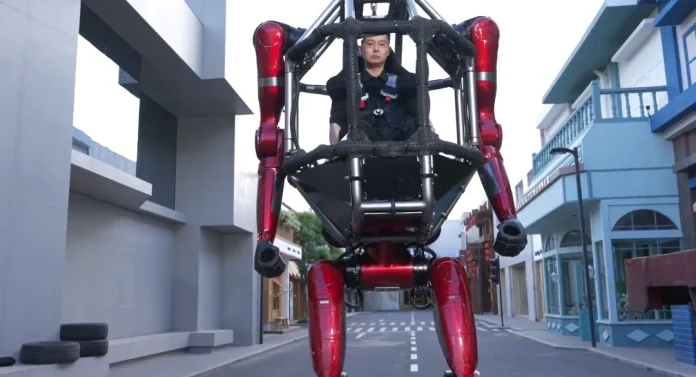
Unitree Robotics, the Hangzhou-based company that has become one of the world’s most prolific makers of legged robots, has unveiled something markedly different from its usual lineup of nimble humanoids and quadrupeds. The GD01 is a manned, transformable mecha, a 500-kilogram machine that carries a human pilot in a torso-mounted cockpit and can reconfigure itself between bipedal walking and four-legged crawling modes. Unitree describes it as the world’s first mass-produced transformable mecha, and the company has confirmed to multiple outlets that it is a real product available for purchase, not a publicity stunt.
The South China Morning Post reports that the starting price is 3.9 million yuan, or approximately US$574,000. Unitree’s founder and chief executive, Xingxing Wang, appeared in the launch video climbing into the GD01’s open-air belly before the machine demonstrated its capabilities: walking upright on two legs, smashing through a wall of cinder blocks with one arm, and then reconfiguring into a four-legged crawl. The robot weighs roughly the same as a grand piano when a pilot is on board.
A Departure from Unitree’s Core Strengths
The GD01 represents a significant departure from the products that made Unitree famous. The company built its reputation on affordable, agile robots: its G1 humanoid starts at around $15,000, roughly one-tenth the price of comparable American-made humanoid robots. Unitree’s competitive advantage has been its mastery of China’s hardware supply chain, which allows it to manufacture sophisticated robotic systems at costs that Western rivals have struggled to match.
The GD01 is a different kind of machine. Where Unitree’s humanoids are designed for research, demonstration, and increasingly for light industrial tasks, the GD01 is explicitly positioned as a civilian transport vehicle, a manned platform for traversing environments that conventional vehicles cannot handle. Wired, which confirmed the product’s existence directly with the company, noted that Unitree’s robots are “either remotely controlled or allowed to perform relatively simple actions autonomously” and that the company’s humanoids “lack the AI needed to perform complex tasks in messy real-world environments.” The GD01 is primarily a remotely operated or semi-autonomous vehicle; its achievement is mechanical and structural rather than cognitive.
The Transformation Mechanism
The GD01’s defining feature is its ability to shift between two locomotion modes. In bipedal mode, it walks upright on two legs, with the pilot seated in the upper body. In quadrupedal mode, the machine bends its upper body forward and uses all four limbs to crawl, which provides greater stability on rough terrain. The transition between modes is executed while the pilot remains on board. Interesting Engineering reports that the GD01 features stable bipedal walking, strong force output sufficient to topple walls, and a quick switch to quadrupedal mode for rough terrain movement.
The robot is built from a high-strength alloy and designed to serve as a civilian transport platform. Unitree has included a disclaimer in its social media posts, asking users to operate the robot “in a friendly and safe manner,” a reminder that a 500-kilogram wall-smashing machine carries significant safety implications.
China’s Robotics Dominance in Context
The GD01 launch comes at a moment when Chinese robotics companies have established a commanding position in the global market. According to Omdia, Chinese manufacturers accounted for nearly 90 percent of global humanoid robot sales in 2025. Unitree alone shipped more than 5,500 humanoid robots during that year, according to a person with knowledge of the matter who spoke to the South China Morning Post. That volume reflects a manufacturing scale-up that American and European competitors have not been able to match, driven in large part by China’s deep and integrated hardware supply chain.
Unitree is expected to go public this year, and the GD01 launch is likely to strengthen its profile ahead of any listing. The company’s robots gained widespread attention earlier in 2026 when dozens of them performed synchronized parkour and martial arts routines at a televised spring festival event, a demonstration that required the robots to communicate wirelessly with each other to coordinate their movements in real time.
(Related: In a Global First, Zhejiang Humanoid Robotics Signs 2,000-Unit Order for Garment Manufacturing)
What the GD01 Is, and Is Not
It is worth being precise about what the GD01 represents. It is a remarkable feat of mechanical engineering: a large, rideable, transforming robot that is being offered as a commercial product at a price point that, while steep, is not out of reach for industrial or government buyers. The bipedal-to-quadrupedal transformation while carrying a pilot is technically demanding, and the machine’s structural integrity under the stresses of wall-demolition and rough terrain traversal speaks to serious engineering capability.
What the GD01 is not, at least at launch, is an autonomous or AI-driven system in the way that term is increasingly used in the robotics industry. It does not perform complex manipulation tasks, navigate unstructured environments without human input, or demonstrate the kind of dexterous, adaptive behavior that companies like Figure, Boston Dynamics, and China’s Agibot are pursuing in their humanoid programs. Its value proposition is physical capability and spectacle, not cognitive sophistication. Wired’s assessment that the GD01 “looks more geared towards destruction and garnering publicity for Unitree than anything else” captures the tension between the machine’s undeniable impressiveness and its limited practical utility at this stage of development.
The Supply Chain Behind the Machine
The fact that Unitree can offer the GD01 for commercial sale at all, rather than displaying it as a research prototype, reflects the depth of China’s robotics supply chain. Building a machine of this scale requires high-torque actuators, precision sensors, and robust power systems that can be sourced and integrated at speed. Unitree’s track record of bringing complex robotic products to market faster and cheaper than Western competitors suggests that the GD01, however niche its initial market, is a credible commercial offering rather than a one-off demonstration.
The broader significance of the GD01 may lie less in the machine itself than in what it signals about the direction of Chinese robotics. The country’s manufacturers have already demonstrated that they can dominate the market for smaller, more agile robots. The GD01 suggests they are now moving up the scale curve, building larger, more powerful platforms that occupy a different part of the market entirely. Whether that market turns out to be disaster response, heavy industry, or something else entirely, the GD01 establishes that Unitree is not content to remain in the segment it already owns.
(Related: Volkswagen Deploys Agentic AI Entirely Inside the Car in China — No Cloud Required)