
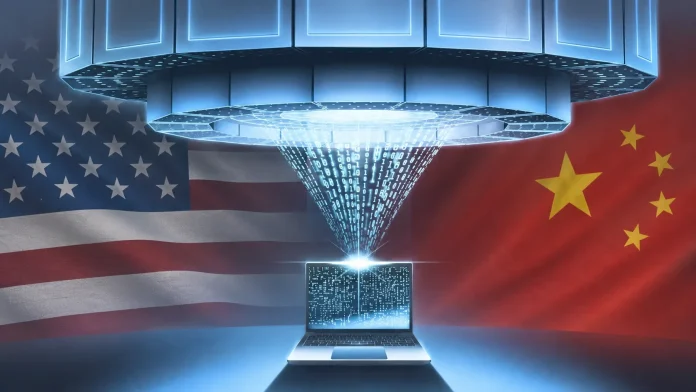
When President Donald Trump and President Xi Jinping sit down in Beijing this week, the agenda will be dominated by the usual geopolitical flashpoints: trade tariffs, Taiwan, and the ongoing conflict in Iran. However, lurking beneath these traditional disputes is a complex, highly technical issue that threatens to upend the entire framework of U.S.-China technology competition: artificial intelligence distillation.
As we reported recently, the White House has accused China of “industrial-scale” theft of U.S. frontier AI models. However, a new analysis in The Diplomat argues that framing this issue merely as “theft” fundamentally misunderstands the nature of the technology. The real challenge lies in the software layer, specifically the process of distillation, which renders traditional hardware-focused export controls increasingly obsolete.
The Limits of Hardware Controls
For the past several years, U.S. tech diplomacy has relied heavily on hardware chokepoints. By restricting China’s access to advanced semiconductors, most notably Nvidia’s high-end GPUs. Washington hoped to stall Beijing’s progress in developing frontier AI models.
However, as Jensen Huang recently admitted, this strategy has largely backfired, accelerating China’s drive for domestic chip self-sufficiency. More importantly, hardware controls fail to address the software layer, where the most significant advancements are currently occurring.
According to the 2026 Stanford AI Index, China’s top AI model now trails the leading U.S. model by a mere 2.7% on benchmark evaluations. Astonishingly, Chinese labs achieved this near-parity with approximately 1/23rd of the financial investment of their American counterparts. This efficiency is largely driven by distillation.
The Mechanics of Distillation
AI distillation, a concept first popularized by Geoffrey Hinton in 2015, involves using a massive, highly capable “teacher” model (like OpenAI’s GPT-4 or Anthropic’s Claude) to train a smaller, more efficient “student” model. The student model learns to mimic the outputs and reasoning patterns of the teacher, effectively absorbing its capabilities without requiring the massive compute resources needed to train the original model from scratch.
This process is incredibly difficult to govern. Unlike a physical microchip, which can be tracked and embargoed, the outputs of a language model are essentially just text data. When Chinese researchers use U.S. models via APIs, even shadow APIs accessed through proxy networks, they can generate vast amounts of synthetic training data to distill into their own domestic models.
The White House memo highlighted this exact dynamic, noting that these campaigns replicate the performance of advanced models “at a fraction of the cost” while deliberately stripping away carefully constructed security protocols.
An Ungovernable Frontier?
The fundamental problem facing U.S. negotiators at the summit is that distillation is an inherent feature of the current AI paradigm. As long as U.S. companies offer API access to their frontier models, the data required for distillation will be available. Attempting to block all Chinese access to these APIs is practically impossible, given the proliferation of VPNs and third-party proxy services.
Furthermore, as The Diplomat points out, the U.S. lacks a coherent policy framework for addressing software-layer competition. Export controls were designed for physical goods, not the ethereal transfer of synthetic data and model weights.
This reality puts the U.S. in a difficult negotiating position. If Washington cannot effectively prevent distillation, its leverage over China’s AI development is significantly diminished. This may explain why, as we noted in our coverage of the proposed AI emergency channel, the U.S. is increasingly focused on establishing communication protocols to manage the risks of advanced AI, rather than solely trying to contain its spread.
Realistic Outcomes
Given the complexities of the software layer, what can realistically be achieved at the Trump-Xi summit regarding AI?
According to analysts, a comprehensive agreement on AI governance or a halt to distillation practices is highly unlikely. The technological realities make enforcement nearly impossible, and Beijing has consistently rejected U.S. claims of “theft,” framing its progress as the result of indigenous innovation.
The most plausible outcome, as suggested by The Diplomat, is a reaffirmation of the “Lima principle,” the agreement reached in November 2024 to keep AI out of the command and control of nuclear weapons. While this may seem like a modest achievement, establishing baseline norms around the most catastrophic risks is a necessary first step.
Ultimately, the summit will highlight the urgent need for a new paradigm in tech diplomacy. The era of relying solely on hardware chokepoints is ending. To effectively navigate the AI competition with China, the U.S. must develop strategies that account for the fluid, ungovernable nature of the software layer and the powerful mechanics of AI distillation.