
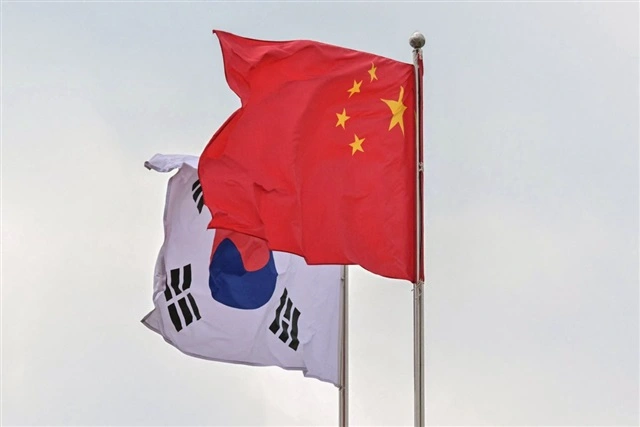
The decades-old industrial relationship between China and South Korea is undergoing a transformation. As China’s technological capabilities rapidly advance, moving from a low-cost manufacturing hub to a global leader in high-tech sectors, South Korea is being forced to rethink its economic strategy. A new report highlights growing calls for the two nations to pivot away from traditional manufacturing competition and toward the establishment of shared standards in artificial intelligence and electric vehicles.
The shifting dynamic is a stark illustration of how the US-China tech war and China’s own industrial upgrading are reshaping regional economies. For years, South Korea enjoyed a comfortable technological lead over China, exporting high-value components and finished goods while relying on China for assembly and lower-end manufacturing. That era is definitively over.
The Shifting Balance of Power
According to a recent analysis by the South China Morning Post, China’s “sharper tech edge” is rapidly eroding South Korea’s traditional advantages. In sectors ranging from shipbuilding and displays to smartphones and memory chips, Chinese companies are not just catching up; they are increasingly setting the pace.
This shift is perhaps most evident in the automotive sector. China has emerged as the undisputed global leader in electric vehicles, dominating the entire supply chain from battery production to final assembly. South Korean automakers, once dominant players in the Chinese market, have seen their market share plummet as domestic consumers flock to technologically advanced and competitively priced Chinese EVs.
The situation is similar in the realm of artificial intelligence. While South Korea boasts a strong tech sector and world-class internet infrastructure, it lacks the massive scale and data resources that have fueled China’s AI boom. As we reported recently, China’s AI apps grew 61.7% in Q1 2026, demonstrating domestic adoption and iteration that are difficult for smaller markets to match.
A Call for Shared Standards
In response to this shifting balance of power, some experts and industry leaders are urging a strategic pivot. Rather than engaging in a zero-sum competition that South Korea is increasingly likely to lose, the two countries should focus on establishing shared technical standards in emerging fields like AI and EVs.
“Industries in each country must re-evaluate their core strengths to build a synergistic, interdependent global supply chain,” said Seo Bong-kyo, head of Samsung Global Research China, speaking at a seminar co-hosted by Renmin University and the South Korean embassy in Beijing. Seo argued that both nations should look beyond conventional rivalry, adding that “China’s push to expand domestic demand offers a new opening for South Korean firms to enter high-value markets”.
This approach aligns with China’s broader strategy of using its massive domestic market to dictate global technology standards. As we noted in a previous analysis, China is quietly building a global AI standard by embedding its technology across the Global South. Partnering with a technologically advanced neighbor like South Korea would lend further credibility and momentum to these efforts.
For South Korea, there are benefits of shared standards. By aligning its technology with the massive Chinese market, South Korean companies can ensure their products remain relevant and competitive. It also provides a hedge against the increasing pressure from the United States to decouple from the Chinese tech ecosystem.
The Geopolitical Tightrope
However, pivoting toward shared standards with China is fraught with geopolitical risk for South Korea. As a key US ally, Seoul is under pressure from Washington to restrict China’s access to advanced technology, particularly in the semiconductor sector.
South Korea is home to Samsung and SK Hynix, two of the world’s leading memory chip manufacturers. The US has repeatedly urged South Korea to align its export controls with Washington’s, limiting the sale of advanced chips and manufacturing equipment to China.
This places South Korea in a delicate position. It must balance its vital security alliance with the US against its deep economic interdependence with China. Establishing shared AI and EV standards with Beijing could be viewed by Washington as a step toward deeper technological integration, potentially triggering pushback or even secondary sanctions.
The Role of Robotics
The complex dynamic between the two countries is also playing out in the robotics sector. As China rapidly expands its robotics exports, South Korea is emerging as a key market.
In a striking example of this trend, a South Korean Buddhist temple recently ordained a Chinese-made Unitree G1 humanoid robot. The decision to use a Chinese robot, rather than a domestic alternative, highlights the growing competitiveness of Chinese robotics firms in terms of price and capability.
A growing reliance on Chinese robotics technology further underscores the need for shared standards. If South Korean factories, hospitals, and even temples are increasingly populated by Chinese robots, ensuring interoperability and data security will become a paramount concern.
Looking Ahead
The call for shared AI and EV standards represents a pragmatic, if politically challenging, response to the new reality of China’s technological prowess. For South Korea, it is an acknowledgment that the days of unquestioned technological superiority are over, and that future competitiveness will likely require a more nuanced and collaborative approach.
For China, partnering with South Korea on standards would be a significant diplomatic and economic victory, helping to solidify its position as a global technology leader and pushing back against US efforts to isolate its tech sector.
Whether the two countries will successfully navigate the geopolitical minefield to establish these shared standards remains to be seen. But the fact that the conversation is happening at all is a clear indication that the tectonic plates of the global technology industry are shifting, and the old alliances and economic models are being rewritten.