
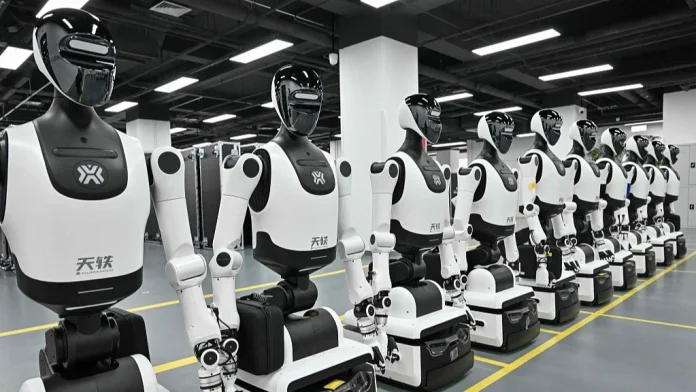
China’s robotics industry has crossed a historic threshold. In the first quarter of 2026, the country’s robot manufacturers exported products worth 11.32 billion yuan (approximately $1.66 billion USD) to 148 countries and regions, according to data released by CCTV+ on May 7. More significantly, China became a net exporter of industrial robots for the first time in its history, a milestone that marks a fundamental reversal in the global robotics trade order.
For decades, China was the world’s largest importer of industrial robots, relying heavily on machines from Japanese manufacturers such as Fanuc and Yaskawa, European companies like KUKA and ABB, and American firms. The country’s factories consumed more industrial robots than any other nation, but the technology behind those machines was overwhelmingly foreign. The Q1 2026 data signals that this era is definitively over.
The Breakdown: Consumer Robots Lead, Industrial Robots Surge
The export figures reveal a two-speed story within China’s robotics sector. Cleaning and vacuum robots, the consumer-facing segment dominated by companies like Ecovacs and Roborock, remain the largest export category by value, accounting for 7.75 billion yuan (approximately $1.14 billion), or 68.5 percent of total robotics exports. This segment has been a Chinese export success story for years, with Chinese brands now commanding dominant market positions across Europe, North America, and Southeast Asia.
The more strategically significant development is the surge in industrial robot exports. Industrial robots, the articulated arms and automated systems that power manufacturing lines, exported 3.16 billion yuan (approximately $463.9 million) in Q1 2026, representing a year-on-year increase of 42 percent. This growth rate far outpaces broader robotics export figures and reflects the rapid maturation of Chinese industrial robot manufacturers such as ESTUN, SIASUN, and Inovance Technology.
The net exporter milestone is particularly meaningful because industrial robots are far more technologically complex than consumer robots. They require precision engineering, advanced control software, and deep integration with manufacturing processes. The fact that China is now selling more industrial robots abroad than it imports is a direct indicator of the technological capabilities its manufacturers have gained over the past decade.
Geographic Reach and Market Diversification
The distribution of Chinese robot exports across 148 countries and regions reflects a deliberate strategy of market diversification. Southeast Asia has emerged as a primary destination, driven by the rapid industrialization of countries like Vietnam, Thailand, and Indonesia, which are building out manufacturing capacity to serve both domestic demand and global supply chains. As we reported recently, Chinese humanoid robots have already begun rolling into Japan’s airports, demonstrating that even the most technologically advanced markets are now open to Chinese robotic systems.
Europe and the Middle East are also significant markets, with Chinese industrial robots finding buyers in automotive, electronics, and logistics sectors. Latin America represents an emerging opportunity, particularly in Brazil and Mexico, where manufacturing investment is accelerating.
This geographic diversification serves a dual purpose. It reduces Chinese robotics companies’ dependence on any single market and insulates them from trade disruptions that have affected other Chinese technology sectors. It also builds the international reference customer base that is essential for winning larger enterprise contracts.
The Policy Tailwind
The robotics export surge is not happening in a vacuum. It is the direct result of a sustained, multi-year government push to develop China’s robotics industry as a strategic national asset. The “Made in China 2025” initiative identified robotics as one of ten priority sectors, and subsequent policy documents have reinforced this commitment with specific production targets, R&D subsidies, and procurement preferences.
More recently, as we reported, MIIT released a draft action plan to raise service robot quality standards, signaling that the government is now focused not just on production volume but on quality and reliability, the attributes that will determine whether Chinese robots can compete at the premium end of global markets. This quality push is essential for long-term export success, as industrial buyers in Europe and North America demand rigorous certification and performance guarantees.
The government’s “anti-involution” policy, which seeks to reduce destructive price competition within the domestic robotics sector, is also relevant here. By discouraging the race to the bottom on domestic pricing, policymakers hope to preserve the profit margins that fund the R&D investments necessary for continued technological advancement.
The Humanoid Frontier
The Q1 2026 export figures do not yet capture the emerging humanoid robot segment, which is still in the early stages of commercial deployment. However, the trajectory is clear. Chinese companies, including Unitree Robotics, UBTECH, and AgiBot, are rapidly advancing their humanoid platforms, with several models now deployed in real-world industrial and service settings.
As we reported, AgiBot’s A2 humanoid made history at the Met Gala, demonstrating the cultural reach of Chinese robotics beyond purely industrial applications. Meanwhile, Morgan Stanley’s latest analysis projects that China’s share of global humanoid robot exports will grow significantly over the next five years, driven by cost advantages and the rapid maturation of the underlying AI and mechanical systems.
The humanoid segment represents both the greatest opportunity and the greatest challenge for Chinese robotics exporters. The opportunity lies in the enormous market potential for robots capable of performing human-like tasks in unstructured environments. The challenge lies in the precision engineering and reliability requirements that humanoid applications demand, requirements that, as a recent MERICS report noted, remain areas where Chinese manufacturers still have work to do.
Looking Ahead
The Q1 2026 export data establishes China’s robotics industry as a genuine global force. The combination of scale, cost competitiveness, and improving technological capability is creating a powerful export machine that is reshaping the global robotics market. The net exporter milestone for industrial robots is not just a statistical curiosity. It is a strategic inflection point that signals China’s arrival as a full-spectrum robotics power.
For international manufacturers, the message is clear: Chinese competition in robotics is no longer limited to the low end of the market. It is moving up the value chain, and the pace of that movement is accelerating.