
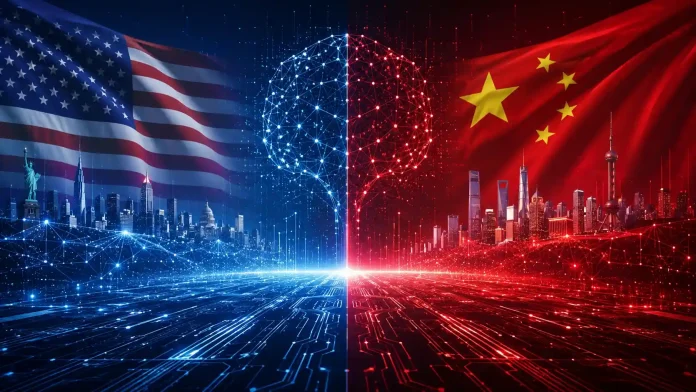
Washington and Beijing are reportedly weighing launching official discussions on artificial intelligence (AI), a move that could place the critical technology on the agenda for the upcoming summit between Donald Trump and Xi Jinping. According to Reuters, citing people familiar with the matter, the White House and the Chinese government are considering this step ahead of the high-stakes meeting scheduled for next week in Beijing.
The potential inclusion of AI in the summit’s agenda underscores the technology’s central role in the broader geopolitical competition between the two superpowers. As both nations race to develop and deploy advanced AI models, the need for high-level dialogue has become increasingly apparent, particularly concerning the military and strategic implications of these systems. The move would represent a significant acknowledgment that AI has graduated from a purely commercial technology dispute to a matter of national security and international stability.
Treasury Secretary to Lead US Delegation
The American side for the proposed AI discussions is expected to be led by Treasury Secretary Scott Bessent. The choice of Bessent suggests that the United States views the AI competition not only through a national security lens but also as a critical economic and trade issue. The economic dimensions of AI—including export controls on advanced semiconductors, the flow of venture capital, and the competitive dynamics of the global AI services market—have been major friction points in recent years.
Beijing, however, has not yet designated its counterpart for the talks. The selection of the Chinese lead will likely provide insight into how the Chinese government intends to approach the discussions—whether focusing on the economic aspects, the regulatory framework, or the strategic and military dimensions of AI. If Beijing appoints a senior official from its technology ministry or the Cyberspace Administration of China, it would signal a preference for a regulatory and governance-focused dialogue. A military or security official, by contrast, would indicate a harder-line posture.
The Strategic Context of the Summit
The upcoming summit in Beijing takes place amid intense technological rivalry. Earlier this week, Donald Trump stated that he intends to remind Xi Jinping that the United States maintains its leadership position in AI. This assertion of dominance sets the stage for potentially contentious discussions, as China has made significant strides in closing the technological gap.
A recent report by Stanford University’s Institute for Human-Centered AI found that the performance gap between top US and Chinese AI models has “effectively closed,” a finding that has sent shockwaves through Silicon Valley. The rapid advancement of models like DeepSeek V4, which achieved near-parity with leading US systems while running on domestic Chinese hardware, has forced a reassessment of the competitive landscape.
The focus on AI at the summit is expected to cover a range of issues. A recent opinion piece in the New York Times noted that the topic of “agentic AI,” systems capable of taking autonomous actions, is anticipated to be on the agenda. The rapid development of these autonomous systems has raised concerns about safety, security, and the potential for unintended consequences, making it a ripe area for bilateral dialogue.
(Related: White House Weighs AI Model Vetting Before Release: Implications for China’s AI Industry)
Military AI and the Need for Dialogue
One of the most pressing areas for potential discussion is the military application of AI. The Center for a New American Security (CNAS) has suggested that Trump should specifically address military AI with Xi, identifying it as an area where both sides might find common ground to implement safety measures and prevent escalation.
The integration of AI into military systems, from autonomous drones to decision-support algorithms, presents novel risks that neither side fully understands. Establishing communication channels and baseline understandings regarding the use of military AI could be a crucial step in managing the strategic competition and avoiding miscalculations. Historical precedents, such as the US-Soviet hotline established during the Cold War, suggest that even adversaries can benefit from mechanisms designed to prevent accidental conflict.
A Complex Technological Détente
The current state of US-China technological relations has been described as an “uneasy détente.” As noted by Reuters Breakingviews, this fragile equilibrium is based on mutual dependencies: China’s reliance on American semiconductor technology and the United States’ reliance on Chinese rare-earth elements and manufacturing capacity.
This interdependence complicates the AI competition. While the US has implemented strict export controls to limit China’s access to the advanced chips necessary for training large language models, Chinese companies have continued to innovate, optimizing their models to run on domestic hardware and finding workarounds to the restrictions. The result is a paradox where US restrictions may have inadvertently accelerated China’s push for technological self-sufficiency.
(Related: US-China Tensions Build Over Iran and AI Ahead of Trump-Xi Summit)
What a Deal Could Look Like
Any formal agreement on AI emerging from the summit would likely be limited in scope, given the deep-seated mistrust between the two sides. Analysts suggest that the most achievable outcome would be a framework for ongoing dialogue, rather than a comprehensive treaty.
Possible areas of agreement could include commitments to notify each other before deploying AI systems in sensitive contexts, shared principles for AI safety and transparency, and cooperation on specific non-military applications such as climate modeling or pandemic response. Even modest agreements in these areas would represent a significant diplomatic achievement and could lay the foundation for more substantive cooperation in the future.
Looking Ahead to the Beijing Meeting
As the summit approaches, the decision to formally include AI on the agenda will be closely watched by industry leaders, policymakers, and international observers. The outcome of these potential discussions could shape the trajectory of global AI development, influencing everything from international safety standards to the flow of technology and capital.
While a comprehensive agreement on AI governance is unlikely to emerge from a single summit, the initiation of official dialogue at the highest levels would represent a significant acknowledgment of the technology’s transformative impact on the US-China relationship. The discussions in Beijing may set the tone for how the two nations manage their technological rivalry in the years to come.