
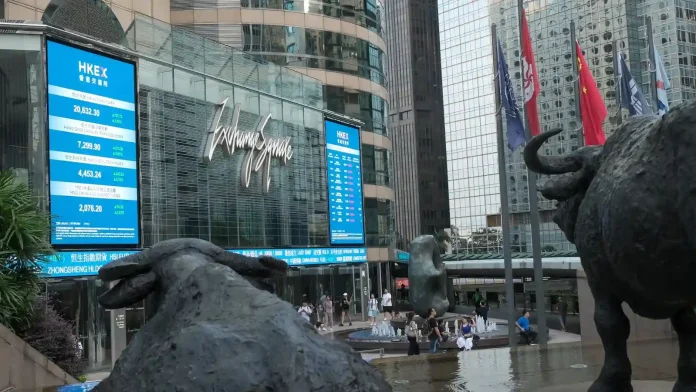
Hong Kong’s IPO Surge: “Much, Much Bigger” Than Anything in 35 Years
Evelyn Cheng at CNBC reports on how Hong Kong is witnessing an extraordinary surge in tech-related initial public offerings (IPOs), signaling the maturation of China’s tech-financial ecosystem and a renewed global capital-market rivalry. Since the outbreak of the Iran war two months ago, foreign capital has flowed robustly into Hong Kong banks, as investors seek exposure to China’s rapidly growing tech sector through the city’s capital markets. This influx has catalyzed a flurry of IPO activity, with more than 400 companies currently queued to list in Hong Kong and over 40 already having gone public this year.
Gary Lock, a veteran IPO adviser at King and Wood in Hong Kong, characterized the current momentum as “much, much bigger” than anything the city has experienced in the last 35 years. This unprecedented boom is not only driven by domestic investors but is increasingly fueled by foreign capital redirecting from volatile global markets toward China’s tech giants and startups. Goldman Sachs analyst Si Fu noted that regulatory hurdles, often a concern in cross-border listings, affect only about 15% of the Hong Kong IPO pipeline, indicating a smoother path for most companies.
The financial stakes are significant. Goldman Sachs projects that the total capital raised through Hong Kong listings will reach approximately $60 billion this year—nearly doubling the $36 billion raised in 2025. This surge is reshaping global perceptions of Hong Kong’s capital markets, traditionally viewed as unable to rival the U.S. in terms of trading volumes and valuations. Jin Yang of KPMG China’s Hangzhou office commented on the resurgence, stating it is “shaking perceptions that Hong Kong can’t match U.S. trading volume or valuations.”
China’s Domestic VCs Grow Up: “Who Needs SoftBank?”
This renewed confidence in Hong Kong’s financial markets is complemented by a striking shift within China’s venture capital landscape. Domestic venture capitalists (VCs) are increasingly offering faster decision-making and more attractive valuations than foreign counterparts, with Lock bluntly asking, “Who needs SoftBank?” This shift underscores a growing confidence and maturity among China’s domestic investors, particularly in sectors aligned with national strategic priorities such as artificial intelligence (AI), semiconductor chips, and commercial aerospace.
Shen Qinhua of Puhua Capital, a prominent Chinese VC firm, revealed that about 60% of their investments are concentrated in “hard tech” areas, including AI, chips, and aerospace. The prioritization of these sectors reflects Beijing’s emphasis on technological self-reliance, an agenda also visible in recent state-backed initiatives and growing AI infrastructure investments.
Additionally, there is an evolving mindset among Chinese founders and entrepreneurs around mergers and acquisitions (M&A). Zhou Kaibing, head of the Hangzhou VC association, observed a marked willingness among founders to explore M&A deals and even sell their businesses, a strategic recalibration that could accelerate consolidation and growth within the tech ecosystem. Qi Ruan from S&R Venture Capital highlighted a parallel trend: investors are now more focused on entrepreneurs with a clear vision for the future, signaling a maturation of investment criteria beyond early-stage enthusiasm.
Hard Tech, India, and the South-South Investment Corridor
The international dimension of this financial ecosystem is also expanding. The recent Hangzhou VC forum attracted over 20 business leaders from India, including representatives from Dharma Capital and Tata. This delegation is actively exploring partnerships and investments in robotics manufacturing, signaling a growing South-South cooperation that could complement China’s ambitions in embodied AI and robotics. This aligns with broader trends of China’s robotics sector expanding rapidly, as demonstrated by the recent successful IPO debut of Manycore Tech, one of Hangzhou’s famed “six little dragons,” which surged dramatically on its April 17 trading debut.
Leading Chinese companies are also making significant capital moves amid this momentum. Battery giant CATL announced a $5 billion share placement, underscoring the deepening integration of AI, energy storage, and advanced manufacturing in China’s tech landscape. However, not all developments have been smooth. The recent blocking of the Meta-Manus deal by Chinese regulators was described as a “draconian development” by some analysts, marking a critical juncture in China’s AI race with the United States and highlighting the complex geopolitical and regulatory dynamics shaping the tech sector.
What the Boom Means for China’s AI and Tech Ambitions
As the May Day Labor Day holiday concluded, the Shanghai and Shenzhen stock exchanges reopened on May 6, signaling continued robust market activity domestically, while Hong Kong’s capital markets remain a preferred gateway for tech IPOs. The city’s ability to attract global capital and list a broad array of companies, from AI startups to chipmakers and embodied robotics firms, positions it as an essential nexus in the evolving China tech financial ecosystem.
The IPO boom in Hong Kong is thus more than a financial phenomenon; it reflects a broader maturation and strategic realignment in China’s tech industry and investment landscape. The city’s capital markets are reclaiming their global crown, supported by a confident domestic VC environment and a growing openness to international collaboration, especially with emerging markets such as India. This convergence of factors underscores Hong Kong’s pivotal role in bridging China’s ambitious AI and tech ambitions with the global financial system.
Investors and analysts will be watching closely how these dynamics evolve, particularly as China seeks to balance regulatory oversight with innovation, and as geopolitical tensions continue to influence cross-border capital flows and technology partnerships. For those tracking the pulse of China’s AI and tech industry, Hong Kong’s IPO frenzy offers a compelling window into the future of one of the world’s most important and rapidly developing technology ecosystems.