
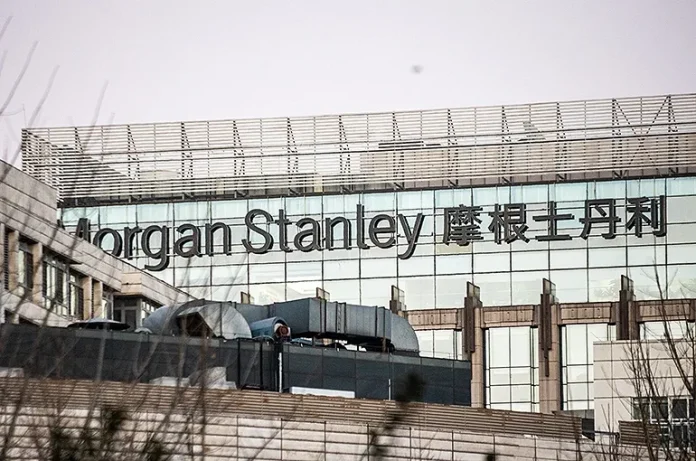
Morgan Stanley has identified a specific, near-term catalyst for Chinese AI stocks that has nothing to do with earnings, product launches, or geopolitical developments: a scheduled index change. CNBC reports that the investment bank forecasts that the inclusion of two Chinese generative AI companies, Knowledge Atlas Technology (the holding entity for Zhipu AI) and MiniMax, into the Hang Seng Tech Index on June 8, 2026, will trigger between $1.25 billion and $1.75 billion in passive investment inflows, according to a report published May 3 and covered by CNBC’s Evelyn Cheng.
The mechanism is straightforward but powerful. Passive funds that track the Hang Seng Tech Index are required by their mandates to hold stocks in proportion to their index weights. When new names are added to the index, those funds must buy in regardless of their own views on valuation or sentiment. With two high-profile AI companies entering simultaneously and with combined index weightings expected to fall between 5 and 7 percent, the resulting mechanical buying will be substantial.
The Price Target Revisions
Morgan Stanley’s response to the index inclusion announcement was to raise its price targets on both stocks, signaling that the bank views the passive inflow catalyst as additive to an already constructive fundamental outlook.
For MiniMax, the bank raised its price target to 1,100 HKD from 990 HKD, an 11 percent upward revision. For Knowledge Atlas Technology, the revision was far more dramatic: the price target was raised to 990 HKD from 560 HKD, a 77 percent increase. The magnitude of the Knowledge Atlas revision reflects the bank’s view that the stock has been significantly undervalued relative to its growth prospects, and that the index inclusion will serve as a re-rating catalyst.
The fundamental case for both companies rests on Morgan Stanley’s forecast for China’s frontier AI model revenue. The bank predicts revenues from China’s top frontier AI models of at least $1 billion by 2026, rising to over $2 billion in 2027. Both MiniMax and Zhipu AI are among the handful of Chinese labs that have demonstrated the capability to develop and commercialize frontier models, and both have been growing their enterprise customer bases rapidly.
The Pricing Gap Narrative
Underlying Morgan Stanley’s bullish view on Chinese AI stocks is a specific thesis about the competitive dynamics of AI model pricing. The bank notes that China’s AI offerings currently cost end-users approximately 17 percent of the rates charged by comparable American models, down from 5 percent a year ago. The narrowing of this pricing differential is significant: it means that Chinese AI companies are capturing more value per unit of compute, shifting from a strategy of pure price competition to one based on performance-based monetization.
This transition matters for investors because it suggests that Chinese AI model companies are moving away from the commoditization trap, the risk that intense domestic competition would drive prices to zero and eliminate margins. MiniMax’s first post-IPO results, published April 30, showed revenue more than doubling year-on-year, confirming that the company is growing its top line at a pace that supports the bank’s revenue forecasts, even as losses widened due to continued investment in model development.
The South China Morning Post’s reporting on DeepSeek V4’s implications for chip demand corroborates Morgan Stanley’s pricing analysis. The SCMP noted that Morgan Stanley described Chinese models as “efficient, delivering performances similar to US peers at only 15 to 20 per cent of inference costs,” a characterization that frames Chinese AI companies not as cheap alternatives but as cost-efficient performers.
Alibaba as a “Global AI Leader”
Beyond MiniMax and Zhipu, Morgan Stanley’s broader China AI thesis includes a prominent role for Alibaba. The bank named Alibaba a “global AI leader” in its report, citing three specific pillars of the company’s AI strategy: T-Head (its in-house chip development arm), AliCloud (its cloud computing platform), and Qwen (its family of large language models).
The T-Head designation is particularly significant. Alibaba’s chip design subsidiary has been developing custom AI accelerators for several years, and its latest generation of inference chips is designed to reduce the company’s dependence on Nvidia hardware for its cloud AI services. As US export controls have effectively cut Nvidia out of the China market, the strategic value of T-Head’s capabilities has increased substantially.
AliCloud’s position as China’s largest cloud provider gives Alibaba a distribution advantage for its Qwen models that smaller AI companies cannot replicate. The combination of proprietary chips, cloud infrastructure, and frontier models, the full vertical stack, is what Morgan Stanley is describing when it calls Alibaba a global AI leader. It is a characterization that would have seemed premature two years ago but is increasingly defensible given the company’s recent investments and results.
The Stock Connect Multiplier
The passive inflow from index inclusion is only the first phase of the capital catalyst identified by Morgan Stanley. The second phase comes when MiniMax and Zhipu join the Stock Connect exchange link program, which Morgan Stanley expects to happen by August 2026. Stock Connect allows mainland Chinese investors to buy Hong Kong-listed stocks directly, and the inclusion of high-profile AI companies in the program typically generates significant buying interest from retail and institutional investors on the mainland.
Morgan Stanley estimates that purchases from mainland investors after Stock Connect inclusion could equal as much as 20 percent of the free-float market capitalizations of both companies within six months of inclusion. Given the valuations at which both companies are currently trading, that implies additional inflows of several hundred million dollars per company, on top of the $1.25 to $1.75 billion from passive index funds.
The combined effect of index inclusion, passive inflows, and Stock Connect buying creates a multi-stage capital catalyst that Morgan Stanley believes the market has not yet fully priced. The bank’s price target revisions are an attempt to quantify that mispricing and signal to clients where the opportunity lies.
Broader Market Implications
The Morgan Stanley report is not just a stock-specific call, it is a statement about the trajectory of Hong Kong’s role in the global AI investment landscape. Hong Kong captured 8 of the world’s 10 largest TMT IPOs in Q1 2026, and the addition of MiniMax and Zhipu to the Hang Seng Tech Index will deepen the city’s position as the primary venue for Chinese AI company valuations.
For international investors seeking exposure to China’s AI industry and increasingly convinced that its competitive position is stronger than the prevailing Western narrative suggests, Hong Kong’s markets are becoming the essential access point. Morgan Stanley’s forecast of $1.75 billion in passive inflows is a data point in a much larger story about how global capital is beginning to price China’s AI capabilities.
(Related:Hong Kong Captures 8 of the World’s 10 Largest TMT IPOs in Q1 2026 | MiniMax More Than Doubles Revenue in First Post-IPO Results but Losses Widen)