
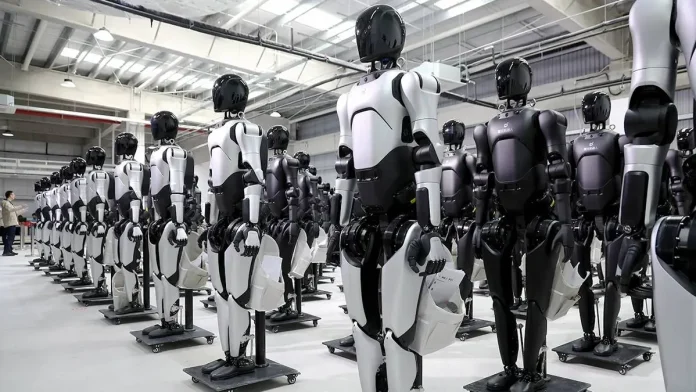
The supply chain that spent the last two decades perfecting the manufacture of smartphones, shaving tolerances to microns, scaling production to hundreds of millions of units per year, and driving component costs down through relentless iteration, is now turning its attention to humanoid robots. The pivot, documented in a detailed analysis by The Next Web published May 3, 2026, represents one of the most consequential industrial transitions in modern manufacturing history, and China is leading it.
The headline data point is Lingyi iTech, a Shenzhen-based precision manufacturer that supplies Apple, Samsung, and Xiaomi. The company has announced it is going “all in” on embodied intelligence, and is building a super factory in Beijing with a target of producing 10,000 humanoid robots per year by the end of 2026 and 500,000 per year by 2030. Those numbers, if achieved, would represent a production scale that no other country’s robotics industry is currently positioned to match.
The Supply Chain Advantage
The connection between smartphone manufacturing and humanoid robotics is not superficial. The two industries share a deep substrate of precision manufacturing capabilities: tight-tolerance machining, miniaturized actuators, high-density electronics assembly, and the logistics infrastructure to manage complex multi-tier supply chains at scale. The companies that built those capabilities for smartphones are discovering that they transfer, with adaptation, to the humanoid robot domain.
The Honor D1 robot, which completed the Beijing half-marathon in April 2026 in 48 minutes and 19 seconds under remote control and 50 minutes and 26 seconds fully autonomously, beating all other robots in a 112-team field, illustrates this transfer directly. The D1 uses liquid-cooling technology derived from Honor’s smartphone division, and its structural components are manufactured by Lens Technology and AAC Technologies. Lens Technology makes the cover glass for iPhones and Samsung Galaxy devices. AAC Technologies is the world’s largest manufacturer of miniature acoustic components for smartphones. Neither company was founded to build robots, but both have the precision manufacturing capabilities that robots require.
The cost implications of this supply chain convergence are significant. Morgan Stanley estimates that material costs for humanoid robots will fall 16 percent as smartphone supply chain efficiencies carry over. Production costs are declining roughly 20 percent annually, a trajectory that mirrors the cost curves that made smartphones ubiquitous. If that trajectory holds, the economics of humanoid robot deployment will reach viability for a much broader range of applications within three to five years.
The Scale of China’s Ambition
Lingyi iTech’s 500,000-unit annual target for 2030 is not an isolated aspiration. It reflects a broader industrial mobilization spanning dozens of companies and receiving explicit government backing. Shenzhen’s robotics industry output reached RMB 242.6 billion in 2025, up 20 percent year-on-year, and the city accounts for 43 percent of China’s total service robot output. The city government has designated embodied intelligence as a strategic industry and is providing land, subsidies, and regulatory support to companies that commit to building production capacity.
UBTech’s Walker S2, which entered mass production in early 2026 with orders exceeding RMB 800 million, is one of the most advanced humanoid robots currently in commercial deployment. UBTech partnered with Foxconn in 2025 to deploy Walker S1 robots on iPhone assembly lines, a partnership that simultaneously validates the technology and deepens the supply chain integration between smartphone and robotics manufacturing.
Foxconn itself is planning humanoid robot manufacturing lines in Vietnam, with production trials scheduled for September 2026 and official production in November 2026. The company’s involvement signals that the largest contract manufacturer in the world, the company that assembles the majority of the world’s iPhones, sees humanoid robots as the next major manufacturing platform.
Morgan Stanley’s Revised Forecast
The investment bank Morgan Stanley has doubled its 2026 forecast for China’s humanoid robot sales to 28,000 units, a 133 percent year-on-year increase. The revision reflects both the faster-than-expected ramp-up in production capacity and the growing pipeline of commercial deployments across manufacturing, logistics, and services.
Morgan Stanley’s longer-term projections are even more striking. The bank projects the global humanoid robot market will reach $5 trillion by 2050, with 25.4 million robots working globally by 2036. China, which currently controls an estimated 90 percent of the global humanoid robot market, is positioned to capture a disproportionate share of that growth, provided it can maintain its manufacturing cost advantage and continue to close the gap with US and European competitors on AI capabilities.
The comparison with Tesla is instructive. Tesla raised its 2026 capital expenditure to $25 billion and is planning to deploy hundreds of Optimus units in 2026. Chinese manufacturers are collectively planning to produce tens of thousands of units in the same period. The scale differential reflects not just different production timelines but fundamentally different industrial strategies: Tesla is pursuing a vertically integrated approach centered on its own manufacturing ecosystem, while Chinese manufacturers are leveraging a distributed supply chain that can scale more rapidly.
The Software-Hardware Integration Challenge
The smartphone supply chain analogy has limits. Smartphones are complex but ultimately static devices, they do not need to perceive their environment, make decisions, and act on those decisions in real time. Humanoid robots do. The manufacturing challenge is not just producing the hardware at scale but also integrating it with the AI software that makes it useful.
This is where China’s AI model ecosystem becomes relevant. The rapid release of four open-weights coding models by Chinese labs in a 12-day window in April 2026, including DeepSeek V4, Kimi K2.6, MiniMax M2.7, and GLM-5.1, demonstrates that China’s AI capabilities are advancing at a pace that can support the software requirements of humanoid robots. The question is whether the integration of hardware and software can be achieved at the production scale that companies like Lingyi iTech are targeting.
The answer, based on current trajectories, appears to be yes, but with significant execution risk. The companies that succeed will be those that can simultaneously scale hardware production, develop robust AI control systems, and build the service infrastructure needed to support deployed robots in commercial environments. China’s smartphone supply chain has demonstrated that it can execute at scale on the hardware side. The software and service layers remain the open questions.
What This Means for Global Manufacturing
The pivot of China’s smartphone supply chain to humanoid robots has implications that extend well beyond China’s borders. The same supply chain that made Chinese smartphone manufacturing dominant, through a combination of scale, cost efficiency, and continuous improvement, is now being applied to a technology that could transform manufacturing, logistics, healthcare, and services globally.
The companies that control the supply chain, Lingyi iTech, Lens Technology, AAC Technologies, Foxconn, and dozens of others, are accumulating the production experience and cost advantages that will be difficult for competitors in other countries to replicate. The window for other countries to build competitive humanoid robot manufacturing capabilities is narrowing, and it may close faster than policymakers currently appreciate.
(Related:The Former Huawei Prodigy at the Forefront of China’s Humanoid Robot Revolution |MERICS Report: China’s Ambitious Path to Transform Its Robotics Industry)