
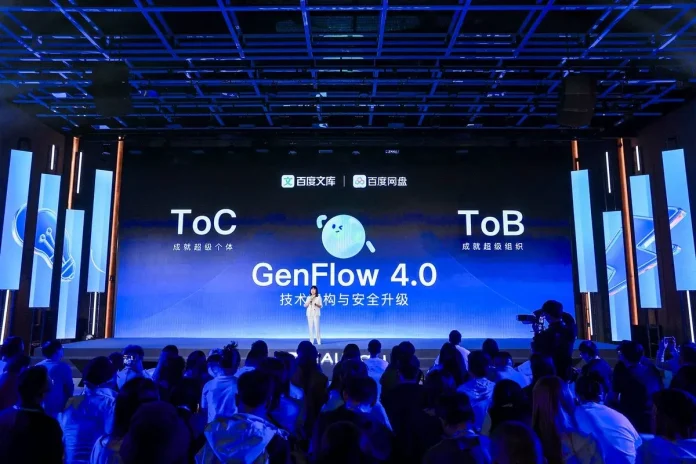
Baidu, China’s leading search engine and artificial intelligence giant, has launched GenFlow 4.0, a major upgrade to its general AI agent platform. The release marks a significant step in Baidu’s strategy to embed AI agents deeply into both enterprise workflows and consumer daily life, further solidifying its position in the fiercely competitive Chinese AI market at a time when rivals like Alibaba, ByteDance, and Moonshot AI are all aggressively pushing their own agent platforms.
Office Agent: Targeting the Enterprise
The GenFlow 4.0 update introduces several key enhancements designed to improve utility across both professional and consumer contexts. At the enterprise level, the platform now features “Office Agent,” a fully revamped suite that allows users to invoke PowerPoint, Excel, and Word agents in parallel from a single prompt. The agent is jointly released by Baidu Wenku and Baidu Drive, and is deeply integrated with OpenClaw, an open-source framework for complex tool use and multi-step reasoning. OpenClaw can be deployed in one click from the Baidu Drive PC or mobile app, effectively turning Baidu Drive into a personal AI workspace.
The Office Agent positions Baidu directly in competition with enterprise productivity platforms that have built large user bases in China’s corporate market. By embedding agent capabilities into the document and file management workflow, Baidu is attempting to make GenFlow the default AI layer for knowledge workers who already use its cloud storage and document tools, a strategy that mirrors how Microsoft has embedded Copilot into Office 365, but targeted at the Chinese enterprise market.
Apollo Go Reaches a Global Milestone
The GenFlow 4.0 launch coincides with a separate but strategically significant milestone for Baidu’s autonomous driving division. On April 1, Baidu announced the launch of a fully driverless commercial ride-hailing service in Dubai through Apollo Go, in partnership with the Roads and Transport Authority and the Dubai Taxi Company. The Dubai deployment marks Apollo Go’s first international app rollout and a meaningful proof point for the platform’s global ambitions. As of February 2026, Apollo Go has completed over 20 million rides worldwide, with weekly rides peaking at more than 300,000 during Q4 2025.
The timing of the GenFlow 4.0 launch alongside the Dubai milestone is not coincidental. Baidu is presenting itself as a company that is advancing simultaneously on multiple AI fronts, agent intelligence, enterprise productivity, and autonomous mobility, at a moment when the robotaxi sector is reaching a critical inflection point, and competition is intensifying from rivals including WeRide and Pony.ai.
The Application Layer Race
The launch also highlights the rapid pace of iteration among Chinese AI firms. While Western companies like OpenAI and Google are focused on building increasingly massive foundational models, Chinese tech giants are aggressively pushing toward the application layer, prioritizing the deployment of functional, task-specific agents. This strategy reflects a pragmatic recognition that the value of AI is ultimately realized at the point of use, not during training.
GenFlow 4.0 represents Baidu’s latest effort to prove that the true value of AI lies not just in raw intelligence but in practical, everyday utility. As the Chinese AI market matures and the initial excitement around foundational models gives way to a focus on real-world applications, Baidu’s deep integration of AI agents across its search, cloud, and autonomous-driving businesses may prove a durable competitive advantage.
Baidu’s Competitive Position
The GenFlow 4.0 launch comes at a critical moment for Baidu. The company has faced intense scrutiny from investors and analysts over the past two years as newer, more agile competitors such as DeepSeek, Moonshot AI, and Zhipu AI have challenged its position as China’s AI incumbent. Baidu’s stock has underperformed the broader Chinese tech sector, reflecting market skepticism about whether its AI investments will translate into sustainable revenue growth.
The Apollo Go integration is Baidu’s most direct answer to that skepticism. Apollo Go is one of the few Chinese AI products already generating meaningful commercial revenue at scale, having surpassed 20 million cumulative rides worldwide as of February 2026, with weekly rides peaking at more than 300,000 during Q4 2025. The platform’s international expansion into Dubai, the first fully driverless commercial deployment outside China, demonstrates that Baidu’s autonomous driving ambitions extend well beyond the domestic market. The combination of a globally expanding robotaxi fleet and a rapidly maturing AI agent platform gives Baidu a structural advantage that pure-play model companies cannot easily replicate.
The Office Agent suite positions Baidu in the enterprise productivity market, where switching costs are high, and incumbents are entrenched. The OpenClaw integration, enabling one-click deployment of a personal AI workspace from Baidu Drive, is designed to lower the barrier to adoption for enterprise users who already rely on Baidu’s cloud storage ecosystem. Whether GenFlow 4.0 can convert that technical convenience into enterprise contracts will be the key metric to watch in Baidu’s next earnings report.