
Alibaba closed out April with two distinct but strategically coherent AI releases: Qwen-Scope, an open suite of sparse autoencoders designed to make the Qwen model family more transparent and controllable, and Happyhorse 1.0, a prompt-driven video editing model that transforms existing footage using natural-language instructions. Taken together, the releases illustrate how Alibaba is pursuing a broader strategy than its rivals — not merely competing on benchmark scores, but building the interpretability tools and creative infrastructure that will define the next phase of AI deployment.
Qwen-Scope: Opening the Black Box
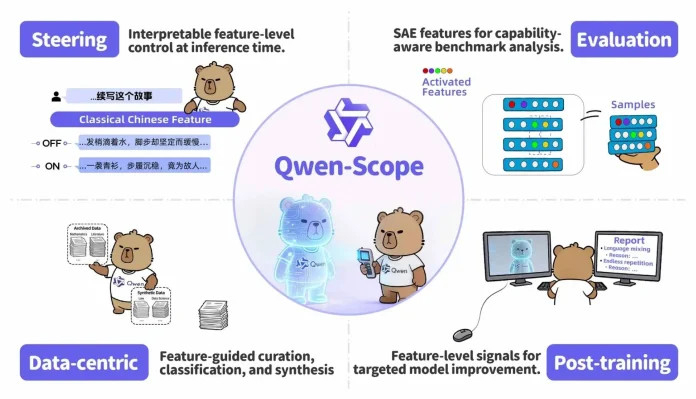
Qwen-Scope is Alibaba’s first major contribution to AI interpretability, a discipline focused on understanding and controlling what happens within large language models. The suite is built around sparse autoencoders, a technique that decomposes the dense, high-dimensional activations of a neural network into a larger set of sparse, human-interpretable features. By mapping which internal components activate in response to specific inputs, researchers and developers can begin to understand why a model produces a given output, rather than simply observing that it does.
The practical applications of Qwen-Scope span four domains. In inference, the suite enables feature-level steering: developers can directly manipulate internal model features to guide outputs without rewriting prompts, a capability particularly valuable for enterprise applications that require consistent, predictable behavior. For data work, the suite supports classification and synthesis using minimal seed examples, improving performance on long-tail use cases where training data is scarce. In training analysis, Qwen-Scope can trace problematic behaviors, such as code-switching between languages or repetitive generation loops, back to their source features, enabling fixes at the foundational level rather than through post-hoc filtering. Finally, the evaluation tools analyze feature activation patterns to identify smarter benchmarks and eliminate redundancy in model performance testing.
The release is available on HuggingFace and ModelScope, accompanied by a technical report. Alibaba has stated that it hopes the development community will use Qwen-Scope to uncover new mechanisms within Qwen models, an open invitation that positions the company as a contributor to the global AI interpretability research agenda, at a moment when Xi Jinping’s call for “original innovation” is pushing Chinese AI labs to move beyond pure benchmark competition.
Happyhorse 1.0: Video Editing at Production Scale
Happyhorse 1.0 Video Edit is a video-to-video model that takes a source clip and a natural-language prompt and generates a transformed version that preserves the structural backbone of the original, camera framing, motion, and scene composition, while reshaping the visual style, atmosphere, lighting, or subject details described in the instructions. The model supports up to nine reference images as visual anchors, enabling tighter control over character identity, brand styling, and art direction than text prompts alone can provide.
The model outputs clips of three to fifteen seconds at 720p or 1080p resolution, with pricing set at $0.70 per five seconds at 720p and $1.40 per five seconds at 1080p. It is available via a production-ready REST API on WaveSpeedAI, with no cold starts and pay-as-you-go billing. The target use cases are explicitly commercial: ad creative adaptation, seasonal campaign refresh, social media optimization, and creative prototyping before full post-production investment. The multi-image reference support is the standout differentiator, allowing performance marketing teams to run a single source clip through multiple prompt and reference-image combinations to generate distinct creative directions in minutes.
Happyhorse 1.0 enters a market that ByteDance’s Seedance 2.0 and Kuaishou’s Kling 3.0 have been rapidly developing, as detailed in the AI micro-drama industry analysis published today. The distinction is that Happyhorse is primarily positioned as a B2B editing tool for existing footage rather than a generative model for creating content from scratch. This positions it closer to the professional post-production workflow than to the consumer-facing AI video generators that have dominated the headlines. As Chinese AI video tools continue to mature, the line between generation and editing is becoming increasingly blurred, and Alibaba, with both Happyhorse and its Wan video generation model, is ensuring it has a presence on both sides of that divide.
The Broader Strategic Picture
The pairing of Qwen-Scope and Happyhorse 1.0 in the same week is not coincidental. Together, they illustrate a deliberate effort by Alibaba to differentiate itself from the benchmark-racing that dominates the Chinese AI market. While rivals like DeepSeek, Moonshot AI, and ByteDance compete primarily on model performance and pricing, Alibaba is building the surrounding infrastructure, including interpretability tools, creative production APIs, and enterprise integrations. That infrastructure transforms raw model capability into deployable business value.
This strategy is particularly relevant in the context of China’s enterprise AI adoption curve. Chinese companies are increasingly willing to deploy AI in production environments, but they require tools that offer predictability, auditability, and control, qualities that raw model benchmarks do not capture. Qwen-Scope addresses the auditability requirement directly. Happyhorse addresses the production-readiness requirement for creative teams. Both releases are designed for the enterprise buyer who needs to explain to a compliance team or a board why a particular AI output was generated and who needs to do so at scale.
Alibaba’s Qwen family has already established itself as one of the most widely deployed open-source model families globally, with particularly strong adoption in Southeast Asia and the Middle East. By releasing Qwen-Scope as an open tool, Alibaba is deepening the ecosystem lock-in for Qwen, making it not just the model of choice but the model for which the most sophisticated interpretability and control tooling exists. In a market where trust and transparency are becoming competitive differentiators, that is a meaningful advantage.