
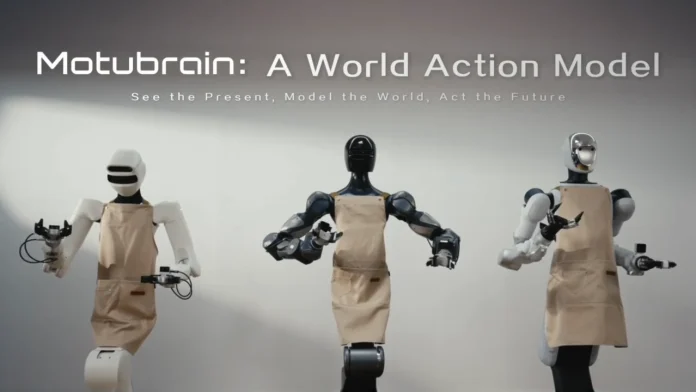
ShengShu Technology, a prominent Chinese artificial intelligence startup, has officially unveiled Motubrain, a highly anticipated “World Action Model” designed to accelerate the development of generalized robotic intelligence. The PR Newswire announcement details the company’s ambitious vision to create a universal “brain” capable of powering a wide array of robotic platforms, from humanoid machines to specialized industrial automation systems.
The launch of Motubrain represents a significant milestone in the rapidly evolving field of embodied intelligence. Unlike traditional robotic control systems that rely on rigid, pre-programmed rules for specific tasks, Motubrain leverages advanced machine learning techniques to understand and interact with the physical world in a more generalized and adaptable manner. This approach aims to overcome the limitations of current robotics, which often struggle to operate effectively in unstructured or novel environments.
(Related: ShengShu Technology Raises $293M Led by Alibaba Cloud to Advance AGI Video Generation)
The Concept of a World Action Model
At the core of ShengShu Technology’s innovation is the concept of a World Action Model (WAM). This paradigm shifts the focus from task-specific programming to building a comprehensive understanding of physical laws, spatial relationships, and object interactions. Motubrain is designed to ingest vast amounts of multimodal data, including visual, spatial, and kinesthetic information, to construct an internal representation of the world.
This internal model allows the system to simulate potential actions and predict their outcomes before executing them in the physical environment. By “imagining” the consequences of its movements, Motubrain can plan complex action sequences, adapt to unexpected obstacles, and learn new skills with significantly less trial-and-error than traditional reinforcement learning methods. The company claims this capability is crucial for achieving true generalized intelligence in robotics, enabling machines to perform a wide variety of tasks without requiring extensive reprogramming for each new application.
The architecture of Motubrain is built upon the foundation of large multimodal models, similar to those used in advanced generative AI systems. However, ShengShu has specifically optimized the model for the unique requirements of robotic control, emphasizing low-latency processing, spatial reasoning, and the translation of high-level semantic instructions into precise motor commands. This integration of cognitive understanding and physical execution is the defining characteristic of the WAM approach.
“One Brain, Infinite Possibilities”
ShengShu Technology’s marketing slogan for Motubrain, “One Brain, Infinite Possibilities,” underscores the platform’s intended versatility. The company envisions Motubrain serving as the underlying intelligence layer for a diverse ecosystem of robotic hardware. Rather than developing specialized software for every new robot design, manufacturers could integrate Motubrain to instantly endow their machines with advanced perception, planning, and execution capabilities.
This hardware-agnostic approach is highly strategic. The robotics industry is currently highly fragmented, with numerous companies developing proprietary hardware and software stacks. By offering a universal intelligence platform, ShengShu aims to become a foundational layer in the robotics ecosystem, similar to how operating systems function in the computing industry. The company has already announced partnerships with several domestic robotics manufacturers to integrate Motubrain into their upcoming product lines, ranging from logistics robots to advanced humanoid prototypes.
The potential applications for a generalized robotic brain are vast. In industrial settings, Motubrain-equipped robots could adapt to changing production lines, handle novel objects, and collaborate more safely with human workers. In domestic environments, the technology could enable service robots to navigate complex household layouts, perform a wider variety of chores, and interact more naturally with users. The ability to learn and generalize across different embodiments and environments is the key value proposition of the Motubrain platform.
China’s Push for Embodied Intelligence
The unveiling of Motubrain aligns perfectly with China’s broader strategic push to dominate the emerging field of embodied intelligence. The Chinese government has identified advanced robotics and AI as critical technologies for future economic competitiveness and industrial upgrading. This strategic focus has catalyzed a surge of investment and innovation within the domestic tech sector, with numerous startups and established giants racing to develop next-generation robotic systems.
ShengShu Technology’s progress with Motubrain highlights the rapid maturation of China’s AI ecosystem. The company, which previously gained recognition for its Vidu text-to-video model, is demonstrating the ability to translate expertise in generative AI into tangible advancements in physical robotics. This cross-pollination of AI disciplines is a key driver of innovation in the field of embodied intelligence.
However, the path to widespread commercialization of generalized robotic intelligence remains challenging. While Motubrain represents a significant conceptual and technical leap, deploying such complex systems in real-world, unstructured environments requires overcoming substantial hurdles related to safety, reliability, and edge computing capabilities. The success of ShengShu Technology and its Motubrain platform will depend not only on the sophistication of its algorithms but also on its ability to forge strong partnerships with hardware manufacturers and navigate the practical complexities of deploying AI in the physical world.
(Related: Guangdong’s Embodied AI Industrial Clusters Are Taking Shape — Here’s What’s Being Built)