
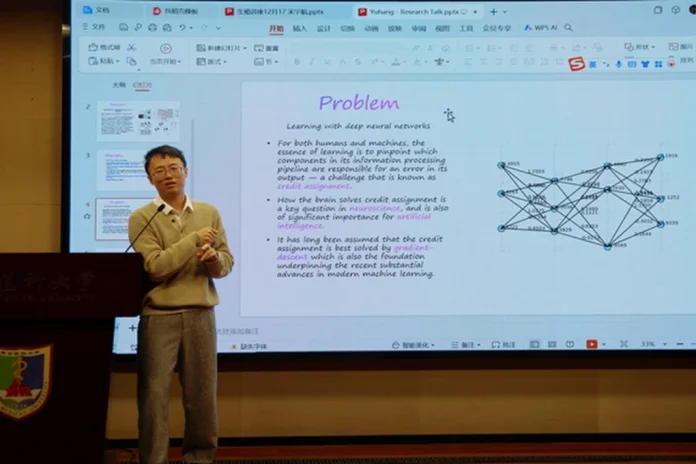
In a significant development for China’s artificial intelligence talent pool, Song Yuhang, a highly regarded AI chip scientist and former co-founder of the UK-based startup Fractile, has returned to his home country. Song has joined Nanjing University’s prestigious School of Artificial Intelligence as an associate professor, where he will lead the newly established Atom of Learning (AtoL) laboratory.
The South China Morning Post has reported that Song’s return earlier this year underscores the intensifying global competition for top-tier AI researchers, particularly those with expertise in advanced semiconductor design. His move from a promising Western startup to a leading Chinese academic institution highlights Beijing’s ongoing efforts to attract overseas talent to bolster its domestic technological capabilities amid tightening US export controls.
A Rising Star in AI Hardware
Song Yuhang’s academic and professional trajectory has been marked by significant achievements. He earned his PhD from the University of Oxford in 2022, during which he published 13 academic papers. His research excellence was recognized globally when he became one of only six recipients worldwide of the prestigious JP Morgan AI Research Award in 2022.
In 2021, while still a doctoral candidate, Song co-founded Fractile alongside fellow Oxford PhD student Walter Goodwin. The startup’s ambitious goal was to design and build AI chips capable of running large language models significantly faster and more efficiently than Nvidia’s industry-leading processors. Fractile quickly gained traction in the competitive European tech ecosystem, securing $17.5 million from venture capitalists and an additional $6.3 million from the UK’s Advanced Research and Invention Agency (ARIA).
The startup’s seed investors included high-profile names such as NATO’s innovation fund, Kindred Capital, and Oxford Science Enterprises. Fractile’s potential was considered so significant that the company was reportedly seeking to raise $200 million at a $1 billion valuation in 2026 to mount a serious challenge to Nvidia’s dominance in the AI hardware market.
The Departure from Fractile
Song’s abrupt departure from Fractile in May 2024 sparked considerable speculation within the UK tech community. According to reports from London’s City AM, his exit was related to concerns over his previous academic links with Beihang University in Beijing. Beihang is known as one of China’s “Seven Sons of National Defence”—a group of universities with strong ties to the Chinese military and defense industry. The university has been on the US government’s entity list for export controls since 2001.
The scrutiny surrounding Song’s background reflects the growing sensitivity in Western countries regarding the transfer of critical technologies, particularly in AI and semiconductors. While neither Song nor Fractile commented on suggestions of intellectual property transfer, and no formal accusations of misconduct were made, a Fractile representative stated only that Song left “to pursue other technical and business interests.”
Following his departure from Fractile, Song was briefly involved with two other AI startups before deciding to return to China and transition back into academia. His appointment at Nanjing University represents a major acquisition for the institution’s highly selective School of Artificial Intelligence. In the 2025 selection cycle, 381 overseas scientists applied for positions at the school, but only 80 were accepted.
Leading the Atom of Learning Laboratory
At Nanjing University, Song will lead the Atom of Learning (AtoL) laboratory, focusing on foundational research in AI hardware and algorithms. The lab is currently recruiting, with capacity for two master’s students and one PhD student for the 2026 entry cycle.
Song’s research philosophy aligns closely with China’s strategic need to innovate beyond the constraints of current hardware architectures. “To achieve a hundredfold leap in the performance of the next generation of AI, we must rebuild from the ground up,” Song was quoted as saying. This perspective is particularly relevant given the US export controls that restrict China’s access to the most advanced AI chips and semiconductor manufacturing equipment.
The return of high-caliber scientists like Song Yuhang is a crucial component of Beijing’s strategy to achieve technological self-reliance. By fostering a robust domestic research ecosystem led by researchers with experience at top global institutions and cutting-edge startups, China aims to accelerate its development of indigenous AI technologies. Song’s expertise in designing novel chip architectures to challenge Nvidia’s paradigm will be highly valuable as China seeks to overcome the hardware bottlenecks currently limiting its AI ambitions.
(Related: China’s AI Talent Race Intensifies as Local Governments and Companies Ramp Up Recruitment)