
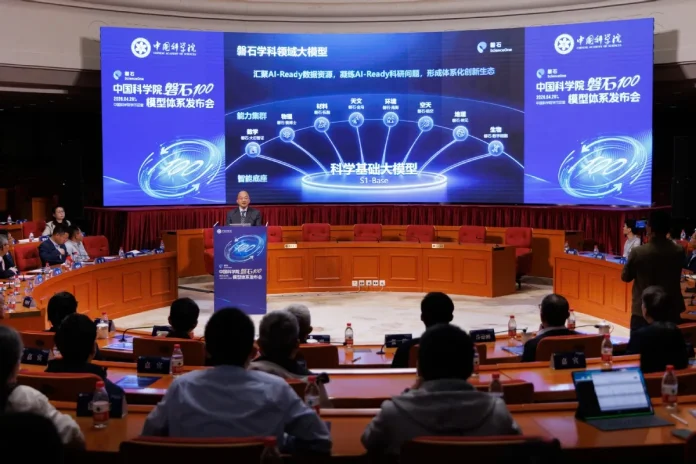
In step forward for artificial intelligence applied to fundamental research, the Chinese Academy of Sciences (CAS) officially unveiled the “ScienceOne 100” (科学一号) AI model system at a launching ceremony in Beijing on April 28, 2026, according to China Daily. Developed by the CAS Institute of Automation in collaboration with several other leading research institutes, ScienceOne represents a comprehensive suite of eight specialized foundation models tailored specifically for scientific domains including mathematics, physics, chemistry, materials science, and life sciences.
The launch of ScienceOne marks a strategic shift in China’s AI development, moving beyond general-purpose large language models (LLMs) like ChatGPT or Ernie Bot, toward highly specialized, domain-specific AI systems designed to accelerate the pace of scientific discovery. The CAS initiative aims to provide researchers with powerful computational tools capable of analyzing massive datasets, simulating complex physical phenomena, and generating novel hypotheses that would be impossible for human scientists to derive manually.
The Eight Pillars of ScienceOne
The ScienceOne 100 system is not a single monolithic model, but rather an integrated ecosystem of eight distinct AI models, each optimized for a specific scientific discipline. While the full technical specifications of all eight models have not been publicly detailed, CAS highlighted several key components during the launch event in Beijing.
One of the flagship models is dedicated to materials science, designed to predict the properties of novel compounds and accelerate the discovery of new materials for applications ranging from advanced batteries to high-temperature superconductors. Another model focuses on computational chemistry, capable of simulating complex chemical reactions and optimizing synthetic pathways for drug discovery. The physics model is reportedly trained on vast amounts of experimental data from particle accelerators and astronomical observatories, aiming to assist physicists in identifying subtle patterns that could point to new fundamental laws of nature.
The mathematics model, perhaps the most ambitious of the suite, is designed not just to solve complex equations, but to assist mathematicians in proving theorems and exploring abstract mathematical structures. By integrating these specialized models under the ScienceOne umbrella, CAS hopes to foster interdisciplinary research, allowing scientists to leverage insights from multiple domains simultaneously.
Overcoming the Data Bottleneck in Science AI
A critical challenge in developing AI for scientific research is the availability of high-quality, domain-specific training data. Unlike general LLMs, which can be trained on vast swaths of text scraped from the internet, scientific AI models require highly structured, rigorously validated data, often generated by expensive experiments or complex simulations.
To address this bottleneck, the CAS Institute of Automation leveraged the vast data repositories maintained by the Chinese Academy of Sciences’ extensive network of research institutes. ScienceOne was trained on a massive corpus of scientific literature, experimental datasets, and simulation results, much of which is proprietary to CAS. This unique access to high-quality scientific data provides ScienceOne with a significant competitive advantage over AI models developed by commercial tech companies, which often lack access to such specialized information.
Furthermore, CAS researchers developed novel training methodologies to ensure the models adhere to fundamental physical laws and scientific principles, rather than simply generating statistically plausible but scientifically nonsensical outputs—a common problem known as “hallucination” in general-purpose LLMs.
Strategic Implications for Global Research
The unveiling of ScienceOne 100 underscores China’s ambition to become a global leader not only in AI technology but also in applying AI to drive fundamental scientific breakthroughs. The Chinese government has repeatedly emphasized the strategic importance of “AI for Science” (AI4S), viewing it as a critical enabler for technological self-reliance and economic competitiveness.
By providing its researchers with state-of-the-art AI tools, China aims to accelerate the discovery of new materials, the development of novel drugs, and the advancement of fundamental physics, areas that are crucial for long-term technological dominance. The ScienceOne system will initially be deployed across the CAS network, but plans are reportedly underway to make the platform accessible to researchers at leading Chinese universities and select industrial partners.
The global scientific community will be watching closely to see how ScienceOne performs in real-world research settings. If the system can consistently generate novel, verifiable scientific insights, it could significantly alter the landscape of global scientific competition, demonstrating that specialized, domain-specific AI models are the key to unlocking the next generation of scientific breakthroughs. The development of ScienceOne also highlights a growing divergence in AI strategies between the US and China, with the latter increasingly prioritizing industrial and scientific applications over consumer-facing chatbots. As the race for AI supremacy intensifies, the ability to harness artificial intelligence for fundamental scientific discovery may prove to be the ultimate differentiator in achieving long-term technological and economic leadership.