
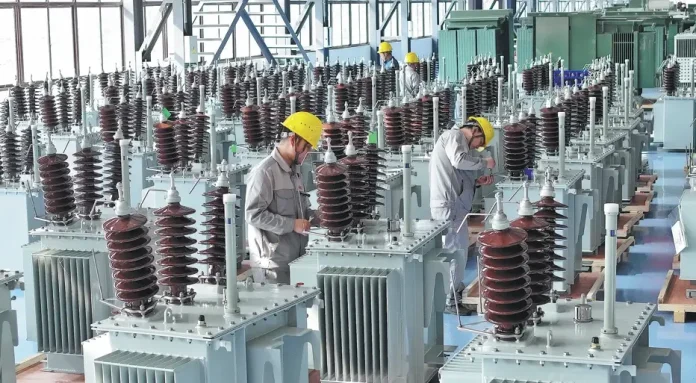
The global race to build artificial intelligence infrastructure has created an unexpected and largely unheralded windfall for China. While the geopolitical debate fixates on advanced semiconductors and export controls, a quieter but equally consequential supply chain story has been unfolding: Chinese manufacturers of transformers, solid-state power systems, and cooling equipment have become indispensable suppliers to the very data center boom that US policymakers are trying to accelerate. The numbers are striking. According to an in-depth report by Caixin Global, China’s power equipment exports rose 26% in 2025 to reach $37.4 billion, with transformers alone accounting for 41% of that total. Chinese firms now hold an estimated 60% of global transformer manufacturing capacity.
The scale of this dependence is most visible in the United States. According to data from Wood Mackenzie, cited by Bloomberg, US utilities imported more than 8,000 high-power transformers from China in 2025, up from fewer than 1,500 units in 2022. That is a more than five-fold increase in just three years, driven almost entirely by the AI data center construction surge. Alphabet, Amazon, Meta, and Microsoft alone are on track to spend over $650 billion on AI capacity in 2026, according to Bloomberg estimates. The physical infrastructure required to support that spending, including the transformers, switchgear, batteries, and cooling systems, is increasingly sourced from China.
The Bottleneck Nobody Talks About
The transformer shortage is one of the most underreported constraints on the global AI build-out. Before 2020, delivery times for high-power transformers ran 24 to 30 months. Today, according to data from Sightline Climate, lead times have stretched to as long as five years, far exceeding the 18-month deployment cycles that data center operators typically plan around. The result is that nearly half of planned US data center projects are being delayed or canceled, Bloomberg reported, not because of chip shortages but because of a lack of power delivery equipment.
China’s manufacturing base is the primary reason the situation is not worse. Chinese firms have the capacity, the supply chains, and the cost structure to produce these components at the volumes required. Delta Greentech, a Shanghai-based data center infrastructure provider, is a case in point. The company is actively scaling up production of solid-state transformers (SSTs) — a next-generation alternative to conventional oil-filled transformers that offers higher efficiency, a smaller footprint, and faster response times. Ye Xinping, a director at Delta Greentech, confirmed at the Bloomberg New Energy Finance Summit in Beijing in March 2026 that the company expects to achieve mass delivery capability for SSTs by the end of 2026.
(Related: China Powers the Global AI Build-Out: Transformers and Cooling Systems Surge)
A Broader Industrial Surge
The power equipment boom is part of a broader acceleration in China’s industrial and high-tech manufacturing sector. Data released by China’s National Bureau of Statistics on April 27 and reported by CNBC shows that industrial profits jumped 15.8% year on year in March — the fastest pace since September 2025 — and expanded 15.5% across the full first quarter, the strongest start to a year since 2017 (excluding the pandemic-driven spike of 2021). Yu Weining, chief statistician at the NBS, attributed the acceleration primarily to the equipment and high-tech manufacturing sectors, which saw profits soar 21% and 47.4% respectively in Q1.
The subsector data tells an even more granular story of AI-driven demand. Profits at optical fiber manufacturers, a critical component for data center interconnects, surged 336.8% year on year in Q1. Optoelectronics and display device makers posted gains of 43% and 36.3% respectively. Drone manufacturers were up 53.8%, and intelligent consumer device makers gained 67.3%. Non-ferrous metal firms, which supply the raw materials for much of this equipment, saw profits jump 116.7% in the first quarter. Zhiwei Zhang, president and chief economist at Pinpoint Asset Management, noted that the improved profitability was “in part underpinned by robust exports,” with China’s total exports growing 14.7% in Q1, the fastest pace since early 2022.
The Paradox of Decoupling
The power equipment story exposes a fundamental tension at the heart of US technology policy. Export controls are designed to limit China’s access to the most advanced American AI systems. But the physical infrastructure required to run those systems, the transformers that power the data centers, the cooling systems that keep the GPUs from overheating, the optical modules that connect them, is overwhelmingly manufactured in China. China also supplies over 40% of US battery imports, according to Bloomberg data.This is not a short-term dependency that can be resolved quickly. Building out domestic transformer manufacturing capacity in the United States or Europe takes years and requires significant capital investment. In the meantime, the AI build-out cannot wait. The result is a deepening structural reliance on Chinese industrial capacity even as governments pursue policies designed to reduce it. For Chinese power equipment makers, this paradox is a commercial opportunity of historic proportions, one that is already showing up clearly in export figures, profit margins, and order books.
(Related: US Chip Export Controls Accelerate China’s Domestic Semiconductor Push)