
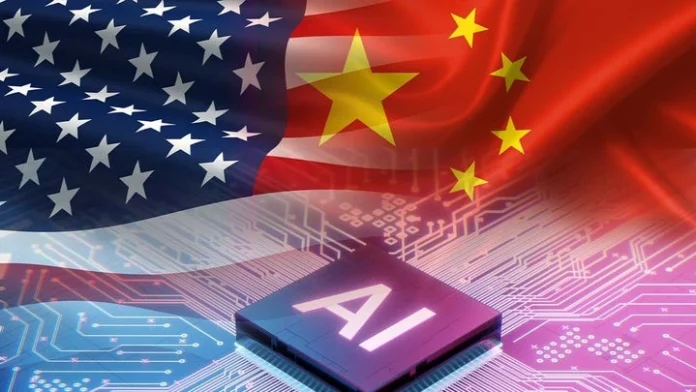
The Chinese government has issued a sharp, unambiguous rebuttal to recent accusations by the United States of the alleged theft of American artificial intelligence technology. In response to claims that Chinese entities are engaged in “industrial-scale” campaigns to distill US frontier AI systems, the Chinese Embassy in Washington characterized the allegations as “pure slander” and “groundless.” The diplomatic pushback, reported by Reuters and Ars Technica on April 24 and 25, 2026, highlights the escalating tensions between the two superpowers over the future of AI development and the legitimacy of China’s technological achievements.
The US accusations stem from a memo by Michael Kratsios, director of the White House Office of Science and Technology Policy, which warned that foreign entities, principally based in China, were deliberately distilling US models using “tens of thousands of proxy accounts to evade detection and using jailbreaking techniques to expose proprietary information.” This was followed by a global diplomatic cable from the US State Department warning allies about the risks of utilizing AI models from Chinese firms like DeepSeek, Moonshot AI, and MiniMax. The Chinese government’s response was swift and categorical. In a statement to Reuters, the Chinese Embassy reiterated that the accusations are “deliberate attacks on China’s development and progress in the AI industry.”
Liu Pengyu, a spokesperson for the Chinese embassy in Washington, went further in comments to the Financial Times, calling the White House accusations “pure slander.” Pengyu stated that “China has always been committed to promoting scientific and technological progress through cooperation and healthy competition,” and added that the country “attaches great importance to the protection of intellectual property rights.” This framing — positioning China as a responsible actor committed to fair competition — is a deliberate counter-narrative to the US portrayal of Chinese AI development as fundamentally dependent on theft.
(Related: House Select Committee: China Buys What It Can and Steals What It Cannot in the AI Race)
The Debate Over Distillation and the Nature of AI Innovation
The core of the dispute centers on AI distillation, in which smaller models are trained on the outputs of larger, more advanced systems. While US officials and some American AI firms view this as a form of intellectual property theft, the practice is widely used across the industry, including by US companies. The legal and ethical status of distillation is genuinely contested: it sits in a gray area between legitimate knowledge transfer and unauthorized replication of proprietary capabilities.
DeepSeek has previously stated that its models are trained on naturally occurring data collected through web crawling, not on synthetic data generated by competitors such as OpenAI. The company has not responded to the latest round of accusations. The broader Chinese government position is that its AI industry’s rapid progress results from genuine research and development investment, not theft. Chinese AI firms have published hundreds of research papers, filed thousands of patents, and built large teams of world-class researchers — evidence that is difficult to reconcile with a narrative of pure technological parasitism.
The controversy is particularly acute given the recent launch of DeepSeek’s V4 model, which claims to rival the performance of leading US models at a fraction of the cost. The Stanford AI Index 2026 found that the US leads China by just 2.7 percent on AI model performance benchmarks, a gap that has narrowed dramatically over the past two years. Whether this convergence is the result of legitimate innovation or illicit distillation is precisely the question at the heart of the current diplomatic dispute.
(Related: The Co-opetition Reality: How China and the US Are Building AI Together While Fighting Over It)
Geopolitical Implications and the Upcoming Summit
The timing of this diplomatic clash is significant, as it occurs just weeks before US President Donald Trump is scheduled to meet with Chinese President Xi Jinping in Beijing. The accusations of AI theft and the subsequent Chinese denials threaten to overshadow the summit and complicate efforts to stabilize the bilateral relationship. The US government is reportedly exploring measures to hold foreign actors accountable for distillation campaigns, which could include new sanctions, export controls, or legal actions under the Economic Espionage Act.
As the tech war intensifies, the narrative surrounding AI development is becoming increasingly polarized. The US portrays China as a bad actor exploiting American innovation, while China frames the US actions as protectionist measures designed to contain its legitimate technological rise. Both narratives contain elements of truth, but neither fully captures the complex reality of a global AI ecosystem in which knowledge, talent, and technology flow across borders, making them difficult to monitor or control. The outcome of this dispute will have profound implications for the global AI ecosystem, potentially leading to further bifurcation and a chilling effect on international scientific collaboration, ultimately harming both sides.
For China’s AI industry, the US accusations carry a particular sting because they arrive at a moment of genuine achievement. The launch of DeepSeek V4, with its 1.6 trillion parameters and competitive benchmark performance, represents a real milestone in Chinese AI development, one that was achieved through years of sustained investment, talent development, and research. The Chinese government’s frustration with the US narrative is understandable: it sees a country that has invested hundreds of billions of dollars in AI, holds 23 times more private AI investment than China, and yet attributes its competitor’s progress primarily to theft rather than to the hard work of Chinese researchers and engineers. Whether or not the distillation accusations have merit, the diplomatic battle over the legitimacy of China’s AI achievements is now a central front in the broader US-China technology competition.