
Alibaba has announced a major expansion of its Qwen artificial intelligence model into the automotive sector, partnering with nine major Chinese automakers to integrate the technology directly into vehicle systems. The announcement, made on April 24, 2026, at the opening of the 2026 Beijing Auto Show and reported by CNBC, marks a significant push to transform cars into intelligent, service-oriented platforms. The integration allows drivers to perform complex tasks such as ordering food delivery, booking hotels, buying attraction tickets, and tracking packages entirely through natural voice commands, without ever touching a screen or opening a separate application.
The system is designed to run on Nvidia’s automotive chip architecture and can operate even with limited network connectivity. By combining on-device processing with cloud-based computing, the Qwen AI can interpret nuanced voice commands, plan multi-step tasks, and seamlessly connect to external services like payments and navigation. This hybrid approach ensures a responsive and reliable user experience, a critical factor for in-car applications where latency and connectivity can be significant issues, particularly in tunnels, underground parking structures, and rural areas.
The announcement was made on the opening day of the Beijing Auto Show 2026, a highly visible platform that underscores Alibaba’s strategic importance to the automotive market. The show, which features 181 world premieres, has become a key showcase for China’s AI ambitions, with virtually every major automaker highlighting its AI integration strategies.
Broad Industry Adoption and the Push for Differentiation
The list of automakers integrating Qwen is extensive, encompassing some of the largest players in the Chinese market. The partners include BYD, Geely, Li Auto, Changan, Dongfeng, BAIC, Great Wall Motor, SAIC Volkswagen, and SAIC IM Motors. This broad adoption underscores the industry’s urgent need to differentiate vehicles through advanced software and digital services, particularly as growth in the electric vehicle market begins to slow and competition on hardware specifications such as battery range, acceleration, and charging speed intensifies to the point where differentiation is increasingly difficult.
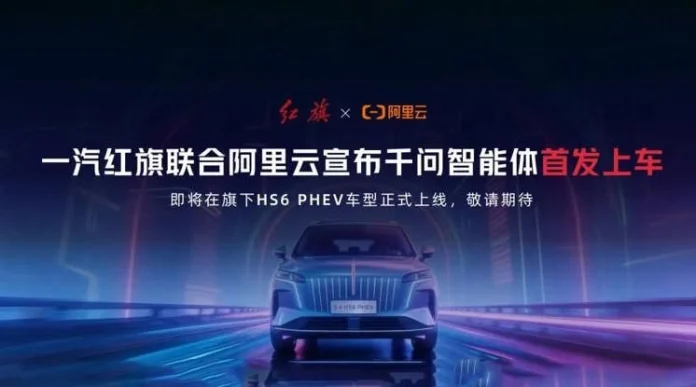
Earlier this year, FAW Group’s Hongqi brand became the first to integrate Qwen into its in-car system, debuting the technology in the Hongqi HS6 plug-in hybrid model. The success of that initial deployment, which provided real-world validation of the system’s reliability and user acceptance, likely paved the way for this broader rollout. As automakers struggle to stand out solely on hardware specifications, the quality and capabilities of the in-car AI assistant are becoming key selling points for Chinese consumers accustomed to highly capable digital services across every other aspect of their lives.
The competitive pressure is also evident in ByteDance’s actions, Alibaba’s main rival in the in-car AI space. A local version of Audi in China announced that its upcoming E7X electric SUV will incorporate AI features from ByteDance’s Doubao and iFlyTek. Similarly, Cadillac showcased a new model with voice-assistant capabilities connected to Doubao AI. The race to embed AI into vehicles is intensifying rapidly, with multiple tech giants competing for partnerships with automakers.
(Related: China’s EV Makers Race to Build Their Own Chips and AI Systems)
The Convergence of Tech and Auto Sectors
The integration of Qwen into millions of vehicles highlights the deepening convergence between China’s technology giants and its automotive industry. By embedding their models directly into the driving experience, companies like Alibaba and ByteDance are securing a massive new user base and a wealth of valuable behavioral data. Every voice command, every service booking, and every navigation request generates data that can be used to improve the AI system, personalize the experience, and develop new commercial services.
It remains unclear whether the AI features will be available in vehicles exported outside China, given the complex regulatory and data privacy requirements of different markets. However, the domestic rollout alone represents an enormous opportunity. With tens of millions of new vehicles sold in China each year, integrating Qwen into even a fraction of those vehicles would create one of the largest deployments of agentic AI in the world. As these systems become more sophisticated, the vehicle will increasingly function as a mobile extension of the user’s digital life, seamlessly connecting them to the broader ecosystem of e-commerce, entertainment, and productivity services.
The strategic value of in-car AI extends well beyond the immediate revenue from service transactions. Each voice interaction generates valuable data about user preferences, travel patterns, and consumption habits that can be used to improve the AI system and to target advertising and promotions. For Alibaba, which generates the majority of its revenue from e-commerce and advertising, the in-car channel represents a new and largely untapped source of high-intent consumer data. As Chinese consumers spend more time in their vehicles, a trend driven by urbanization, longer commutes, and the growing popularity of road trips, the car is becoming an increasingly important touchpoint in the digital economy. Alibaba’s early mover advantage in this space, secured through its Qwen partnerships with nine major automakers, could prove to be one of its most valuable strategic assets in the years ahead.